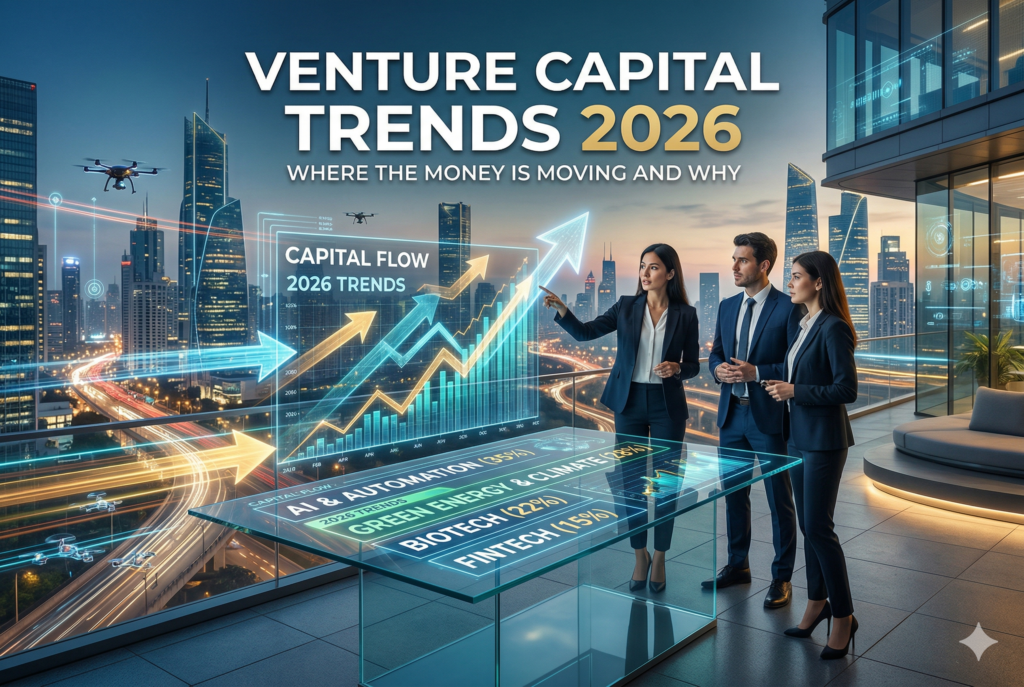
Global venture capital investment in 2025 totaled approximately $285B, a meaningful recovery from the 2023 trough of $238B but still well below the 2021 peak of $621B. The distribution of that capital across sectors, stages, and geographies tells a more interesting story than the aggregate trend. AI dominates headline allocations. Climate and defense technology are capturing institutional interest disproportionate to their historical share.
Key Takeaways
- Global VC investment reached approximately $285B in 2025, up from $238B in 2023 but below the $621B 2021 peak
- AI and AI-infrastructure companies captured an estimated 34% of total global VC investment in 2025
- Median seed round size grew from $2.1M in 2021 to $3.4M in 2025, while median Series A size declined slightly from $18.5M to $16.2M
- Defense technology investment reached $35B globally in 2025, more than doubling its 2022 allocation
- Climate tech investment maintained above $60B for the third consecutive year
- Down rounds among late-stage companies rose to 31% of late-stage transactions in 2024, before declining to 19% in 2025 as valuations stabilized
- U.S. VC deal count declined 18% from 2022 to 2024, with capital concentration in fewer, larger checks increasing
Investment Volume, Stage Distribution, and Sector Allocation
The shape of the VC investment funnel has changed materially since 2021. Seed stage activity by deal count has held relatively steady, as the cost of early-stage software experimentation has remained low. Series A and Series B deal counts declined more sharply, reflecting investor selectivity and the overhang of 2021 vintage companies still working through their capital cycles.
AI and AI infrastructure’s 34% share of 2025 global VC investment represents a concentration level not seen in a single sector since the mobile and internet infrastructure waves of earlier decades. Large language model infrastructure, AI developer tools, and vertical AI applications are simultaneously the most defensible and the most crowded investment categories.
Defense technology’s growth to $35B globally marks a structural reorientation. The category was effectively off-limits for many institutional VCs a decade ago; geopolitical developments since 2022 have normalized defense tech investment across most major funds. Autonomous systems, cybersecurity, satellite intelligence, and communication infrastructure are the primary sub-categories.
Climate tech’s sustained investment above $60B annually is notable for its persistence through the broader VC correction. Federal policy instruments are providing non-dilutive capital alongside equity investment that reduces the risk profile of climate tech companies.
Valuation Dynamics, Fund Economics, and Return Data
2018 to 2019 vintage funds are showing respectable IRR in the 18 to 24% range for top-quartile managers. 2021 vintage funds are under performance pressure, with early marks indicating that the high entry prices of that period will compress realized returns.
Median pre-money valuation at seed decreased from approximately $12M in 2021 to $9.5M in 2025. Series A median pre-money valuations declined from $65M in 2021 to $42M in 2025 — a 35% compression that has produced better risk-adjusted entry points for investors.
Down round frequency peaked in 2024 at 31% of late-stage transactions. The decline to 19% in 2025 reflects a combination of true valuation recovery and the completion of many 2021 vintage forced-repricing events.
Venture debt grew significantly as a complement to equity. Surveyed venture-backed companies report that 34% have accessed venture debt financing, up from 21% in 2021.
Geographic Distribution and Emerging Market Capital Flows
U.S. VC investment retained approximately 48% of global deal value in 2025, down from 53% in 2021. India’s venture market received approximately $18B in 2025. European VC recovered to approximately $48B in 2025, with AI and deep tech categories capturing disproportionate share. China-facing VC investment by U.S.-based managers continued its multi-year decline, falling to estimated $8B in 2025.
Leading Platforms in This Space
Andreessen Horowitz (a16z) has become the most visible institutional VC through its AI-first investment thesis, media platform, and accelerator programs.
Sequoia Capital maintains global coverage through its partnership structure across the U.S., Europe, India, and Southeast Asia.
Lightspeed Venture Partners focuses on enterprise SaaS, consumer technology, and emerging market growth.
General Catalyst has expanded its scope to include health system transformation and AI, alongside traditional SaaS and consumer tech investments.
Coatue Management operates across public and private markets with significant technology portfolio exposure.
Founders Fund maintains a deep tech and defense focus, with notable investments in space, AI, and biotechnology.
Khosla Ventures focuses on deep tech and AI investments, spanning climate technology, health AI, and semiconductor design.
Bessemer Venture Partners maintains a SaaS-focused investment practice with one of the longest track records in enterprise cloud software investment.
Tiger Global reduced its private market deployment significantly from 2021 peak levels but remains a relevant late-stage investor.
GV (Google Ventures) provides corporate VC exposure to enterprise software, life sciences, and AI with the added dimension of Google ecosystem partnership access.
Platform Comparisons and Alternatives
Traditional equity VC versus rolling venture funds differ in LP liquidity, capital concentration, and decision-making speed. Rolling funds allow GPs to raise capital continuously and invest faster; traditional funds concentrate capital in defined vintages with fixed investment periods.
Generalist VC versus thesis-driven specialist funds show performance divergence at the sector level. In periods of concentrated sector performance, specialist funds outperform generalists within their focus sector. Generalist funds offer better diversification across technology cycles.
Corporate venture capital plays a distinct role, deploying capital with strategic alignment requirements that differ from pure financial return optimization. CVC deal count grew 11% in 2024, as large technology and industrial companies used minority investment to access AI, climate tech, and sector-specific software innovation.
What the Data Signals for 2027 and Beyond
AI investment concentration will persist through 2027 but will show increasing differentiation between AI infrastructure (which will attract sustained capital) and AI applications (where returns will concentrate in a small number of winners).
VC exit environments will improve as IPO windows reopen. Rate stabilization, public market valuation recovery, and the passage of time resolving 2021 vintage overhang will create conditions for increased IPO activity in 2026 and 2027.
Secondary market liquidity will grow as a structural feature of the venture asset class. The $130B secondary transaction market of 2025 is expected to grow to over $200B by 2027 as LP-directed fund restructurings and GP-led continuation vehicles expand.
Methodology
Data in this report draws on aggregated venture capital investment databases, publicly available fund performance research, LP reporting data from pension and endowment transparency requirements, and modeled investment volume estimates for categories where comprehensive public data is unavailable.
Conclusion
Venture capital in 2026 is a more disciplined, more selective, and more AI-concentrated market than the 2021 peak cycle. The efficiency-driven reset has produced better investment entry points, more rigorous capital deployment, and clearer sector prioritization. AI, climate, and defense technology represent the thematic allocation story of the decade’s second half — and the investors who positioned into those categories from 2022 forward will likely show the best risk-adjusted returns of the 2025 to 2030 exit window.

We operate independently with no outside influence, ensuring every insight is grounded in objective analysis.
Independent research.
Clear insights.
Smarter decisions.
Contact