CRM Platform Selection for Mid-Market Companies: A Comprehensive Guide
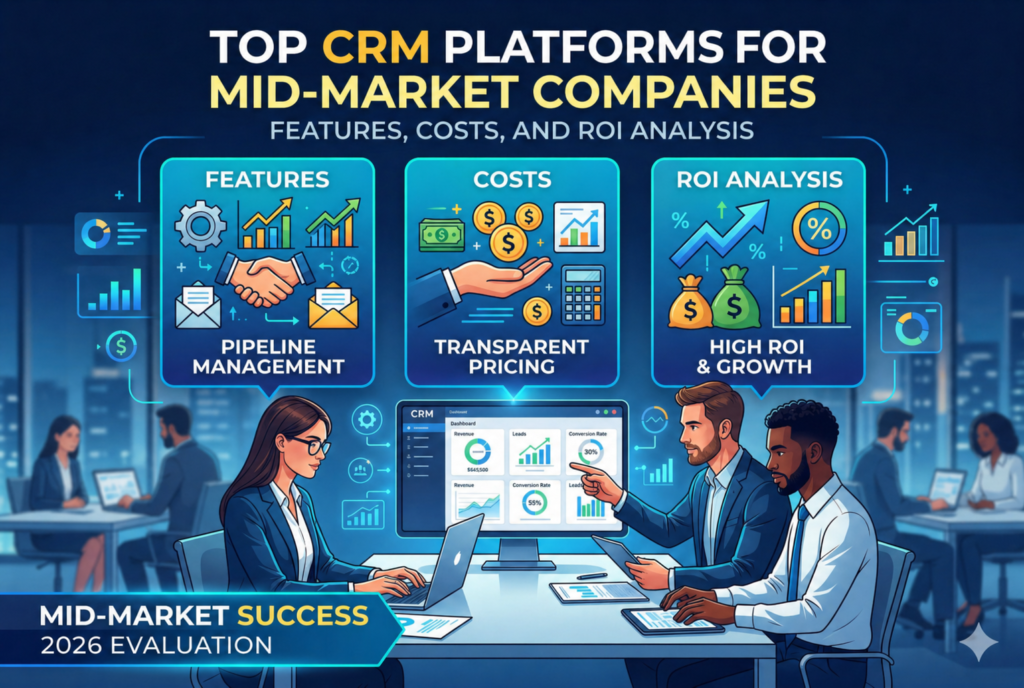
CRM platform selection for mid-market companies is one of the highest-stakes technology decisions the segment makes, precisely because the system becomes embedded in revenue-generating workflows rather than back-office processes. Unlike an ERP or HRIS, a CRM sits at the intersection of sales execution, customer experience, and revenue forecasting — which means a poor selection doesn’t just create inefficiency, it creates compounding drag on the activities most directly tied to growth. Effective CRM selection, by contrast, creates a durable foundation for sales, marketing, and customer success alignment that directly influences revenue retention and expansion over years.
Key Takeaways
- CRM adoption among mid-market companies reached 81% by 2025, with 23% having replaced their initial platform at least once
- Average CRM total cost of ownership in the mid-market ranges from $85,000 to $650,000 annually, depending on platform, seat count, and implementation complexity
- Companies with CRM platforms fully integrated into marketing and finance systems report 31% higher sales productivity compared to those managing CRM in isolation
- Time-to-value after CRM implementation averages 14 months for enterprise-oriented platforms and 5 months for mid-market-native platforms
- AI-assisted CRM features (lead scoring, opportunity forecasting, next-best-action) are now present in 74% of new CRM deployments
- CRM data quality issues affect an estimated 29% of sales forecasts, producing systematic revenue prediction errors
- Companies that implement CRM-native marketing automation report 22% lower customer acquisition costs versus those using disconnected marketing and CRM tools
CRM Adoption Patterns and Platform Evolution
CRM adoption in the mid-market has reached near-saturation from a basic deployment perspective, but the quality distribution of those deployments ranges widely. Approximately 30% of mid-market CRM installations are considered underperforming relative to their potential, based on usage rate data from CRM platform analytics. This distinction — between having a CRM and genuinely leveraging one — is arguably the most important nuance for mid-market buyers entering the evaluation process.
The most common failure modes are consistent across industries and company sizes: low data quality (incomplete contact and opportunity records that erode trust in the system), low user adoption (salespeople maintaining shadow spreadsheets that duplicate and contradict CRM data), and inadequate integration with adjacent systems like marketing automation, ERP, and customer support platforms.
Platform replacement rates have increased meaningfully over the past several years. The 23% of mid-market companies that have replaced their CRM at least once reflects that initial selection decisions made in the 2015 to 2020 period frequently underestimated scalability requirements and total cost of ownership. Companies that selected entry-level platforms based on favorable initial pricing often found themselves constrained as their sales teams grew, their processes became more complex, and their integration requirements expanded. Conversely, companies that selected enterprise-grade platforms without adequate implementation planning often found that complexity itself became a barrier to adoption.
AI integration has become a baseline expectation rather than a differentiating feature in the current market. The 74% figure for AI-assisted features in new deployments reflects the rapid integration of machine learning capabilities into CRM platforms over the past three years. Lead scoring, opportunity win probability modeling, and AI-generated communication summaries are now present across most major platforms at most pricing tiers. Buyers evaluating platforms today should ask not whether AI features exist, but how those features are trained, what data they require to function effectively, and how transparent the underlying models are to sales managers who need to trust and act on their outputs.
CRM Cost Structures and Total Cost of Ownership
CRM licensing represents only a portion of true platform cost, and buyers who anchor their evaluation on per-seat licensing costs frequently encounter significant budget surprises during and after implementation. For enterprise-oriented platforms deployed in the mid-market — primarily Salesforce and Microsoft Dynamics — licensing costs average 40 to 55% of total three-year cost of ownership. Implementation, customization, training, and ongoing administration account for the remaining 45 to 60%.
Mid-market-native platforms carry a meaningfully different cost structure. Licensing is a higher proportion of total cost — typically 60 to 70% — with lower implementation and customization overhead reflecting more opinionated, less flexible platforms that require less professional services work to stand up. Total three-year cost of ownership for a 50-seat mid-market CRM deployment ranges from roughly $250,000 for mid-market-native platforms to over $1.5 million for complex Salesforce implementations requiring significant customization, integration work, and dedicated administration.
Integration cost is the most consistently underestimated CRM cost component, and it deserves particular attention from buyers who manage complex technology stacks. Surveyed mid-market IT teams report spending 18 to 31% of total CRM budget on integration work — connecting CRM to ERP systems, marketing automation platforms, customer support tools, and financial reporting environments. This cost is largely unavoidable for companies that want to realize the productivity benefits of a connected revenue operations environment, but it can be substantially mitigated by selecting platforms with native integration capabilities or pre-built connectors to the specific systems already in use.
Salesforce administration represents a structural cost that buyers evaluating the platform must account for explicitly. Experienced Salesforce administrators command market salaries of $95,000 to $145,000 annually, and the platform’s flexibility and complexity typically requires dedicated administrative resources at 75 to 100 seats. For mid-market companies without existing Salesforce expertise on staff, this creates both a hiring requirement and an ongoing salary cost that smaller CRM alternatives avoid entirely. Some companies address this through managed service arrangements with Salesforce implementation partners, but these arrangements carry their own ongoing cost structures.
CRM ROI Drivers and Performance Measurement
The 31% sales productivity improvement reported by companies with fully integrated CRM environments has multiple contributing factors that are worth disaggregating. The most significant drivers are the elimination of manual data re-entry across systems, the availability of consistent customer context across sales, service, and marketing interactions, and the pipeline analytics capabilities that identify deal risk earlier in the sales cycle — enabling proactive intervention rather than post-mortem analysis.
Revenue forecast accuracy improvement is among the most directly and objectively measurable CRM ROI dimensions, which makes it particularly valuable for building internal business cases. Companies that systematically use CRM pipeline data for revenue forecasting report 19% higher forecast accuracy on a within-10% variance basis compared to companies using non-CRM methods. This improvement translates directly into better resource planning, more accurate financial guidance, and reduced operational disruption from revenue surprises.
Time-to-close improvements from CRM-assisted deal management average 14% in surveyed organizations. This metric tends to be more variable than forecast accuracy improvements, because it depends heavily on sales process maturity, data discipline, and the specific workflows that have been built into the CRM. Companies with structured sales stages, defined exit criteria for each stage, and consistent data entry practices realize significantly larger time-to-close improvements than those using CRM primarily as a contact database.
Customer acquisition cost reduction through CRM-native marketing automation — the 22% improvement cited in the data — reflects the elimination of the data synchronization friction between separate marketing and CRM systems. When lead behavior data, campaign attribution, and CRM opportunity data exist in the same environment, marketing teams can optimize spend allocation based on actual pipeline and revenue outcomes rather than marketing-qualified lead proxies.
Leading Platforms in This Space
Salesforce Sales Cloud remains the category reference point for CRM capability and ecosystem breadth. The platform spans sales, service, marketing, and analytics, and the AppExchange marketplace contains thousands of integrated applications covering virtually every industry vertical and functional use case. For mid-market companies with complex sales processes, significant customization requirements, or plans to scale into enterprise territory, Salesforce remains the most defensible selection — but buyers should enter with clear-eyed expectations about implementation complexity and ongoing administration requirements.
HubSpot CRM has become the most popular mid-market-native CRM by new adoption volume over the past three years, driven by a freemium entry point that allows organizations to begin using the platform before committing to paid tiers, and by strong native integration with HubSpot’s marketing automation suite. For mid-market companies where marketing and sales alignment is a priority, HubSpot’s unified data model provides structural advantages over platforms that require integration work to connect marketing and sales data.
Microsoft Dynamics 365 Sales offers deep Microsoft 365 integration advantages that are particularly compelling for organizations already standardized on Microsoft’s productivity stack. Teams, Outlook, and Excel integration reduces friction in user adoption, and pricing through existing Microsoft enterprise agreements can provide cost advantages relative to standalone CRM contracts.
Zoho CRM provides comprehensive CRM functionality at significantly lower per-seat costs than enterprise alternatives, making it a strong consideration for mid-market companies with cost-constrained budgets that still require robust pipeline management, automation, and reporting capabilities.
Pipedrive serves mid-market sales teams with a pipeline-focused, activity-driven interface that consistently scores highly on sales rep usability. The platform’s opinionated design reflects a clear philosophy about how B2B sales processes should be managed, which creates fast adoption among sales teams but may constrain organizations with significantly different process requirements.
Freshsales (Freshworks) provides an AI-enriched mid-market CRM with built-in phone, email, and chat capabilities that reduce the need for separate communication tools. The platform’s native communication features are particularly valuable for inside sales teams with high outreach volume.
Copper focuses exclusively on Google Workspace-native CRM with automated data entry from Gmail and Calendar, eliminating the manual logging burden that is one of the most common drivers of low CRM adoption. For organizations fully standardized on Google Workspace, Copper’s frictionless data capture model addresses a fundamental adoption challenge.
Insightly targets mid-market professional services and technology companies with project management capabilities alongside traditional CRM features, making it appropriate for businesses where the transition from won opportunity to delivered project is a critical workflow.
SugarCRM provides enterprise-grade CRM with both cloud and on-premise deployment options, serving organizations with data residency requirements or security policies that make cloud-only platforms problematic.
Monday CRM has converted work management platform customers into CRM users through integrated sales workflow tools, representing a different approach to the market that emphasizes flexibility and visual workflow management over CRM-specific depth.
Platform Comparisons
Salesforce versus HubSpot is the most common mid-market CRM evaluation comparison, and the decision framework is relatively clear when stated directly. Salesforce offers greater customization depth, a more mature and extensive AppExchange ecosystem, and a higher scalability ceiling for organizations that will grow into hundreds of sales users. HubSpot offers faster implementation timelines, lower total cost of ownership at mid-market scale, better native marketing automation integration, and consistently higher user adoption rates. The decision typically correlates with deal complexity and sales cycle length: companies with complex, multi-stakeholder enterprise sales processes tend toward Salesforce; companies with higher-velocity, marketing-influenced pipelines tend toward HubSpot.
The broader choice between enterprise CRM platforms and mid-market-native platforms differs primarily in scalability ceiling, customization flexibility, and implementation complexity. Enterprise platforms scale to hundreds of sales users and arbitrary process complexity; mid-market platforms optimize for faster deployment, lower administration overhead, and higher adoption rates within their design constraints.
What the Data Signals for 2027 and Beyond
AI agents that autonomously execute CRM data maintenance — updating contact records, logging interaction history, and progressing deal stages based on email and call data without manual input — will reach meaningful deployment in the 2026 to 2028 window. This capability directly addresses the user adoption problem that has undermined CRM value for two decades: if the system maintains itself, the friction of data entry disappears as a barrier to usage.
Vertical CRM platforms will continue to capture share from horizontal platforms in regulated and process-intensive industries. Healthcare, financial services, and real estate are seeing purpose-built CRM alternatives gain traction by offering pre-built compliance workflows, industry-specific data models, and terminology that matches how practitioners in those fields actually work.
CRM consolidation at the platform level will accelerate as buyers push back against the proliferation of point solutions. The pattern of adding customer success, revenue operations, and marketing automation as separate platforms on top of core CRM — each with its own data model and synchronization requirements — is being challenged by platforms that offer all capabilities within a single data environment, eliminating integration overhead and providing a genuinely unified view of the customer relationship.
Methodology
This report draws on CRM market research, vendor pricing data from public sources and buyer interviews, adoption surveys across mid-market companies, and third-party analyst research on CRM platform performance and total cost of ownership. ROI figures represent averages from multiple research studies and vendor-published case data.
Conclusion
CRM platform selection in the mid-market is a consequential decision with multi-year implications for revenue operations, data quality, sales productivity, and customer experience. The total cost of ownership extends well beyond licensing, the implementation complexity of enterprise platforms is routinely underestimated, and the gap between CRM deployment and genuine CRM adoption remains the most persistent challenge in the category. The highest ROI CRM deployments consistently share three characteristics regardless of which platform is selected: clean, consistently maintained data practices; deep integration with adjacent marketing and finance systems; and structured adoption programs that drive genuine sales team usage rather than compliance-level data entry. Buyers who focus their evaluation on these operational preconditions — rather than feature checklists alone — consistently achieve better outcomes from their CRM investments.

We operate independently with no outside influence, ensuring every insight is grounded in objective analysis.
Independent research.
Clear insights.
Smarter decisions.
Contact