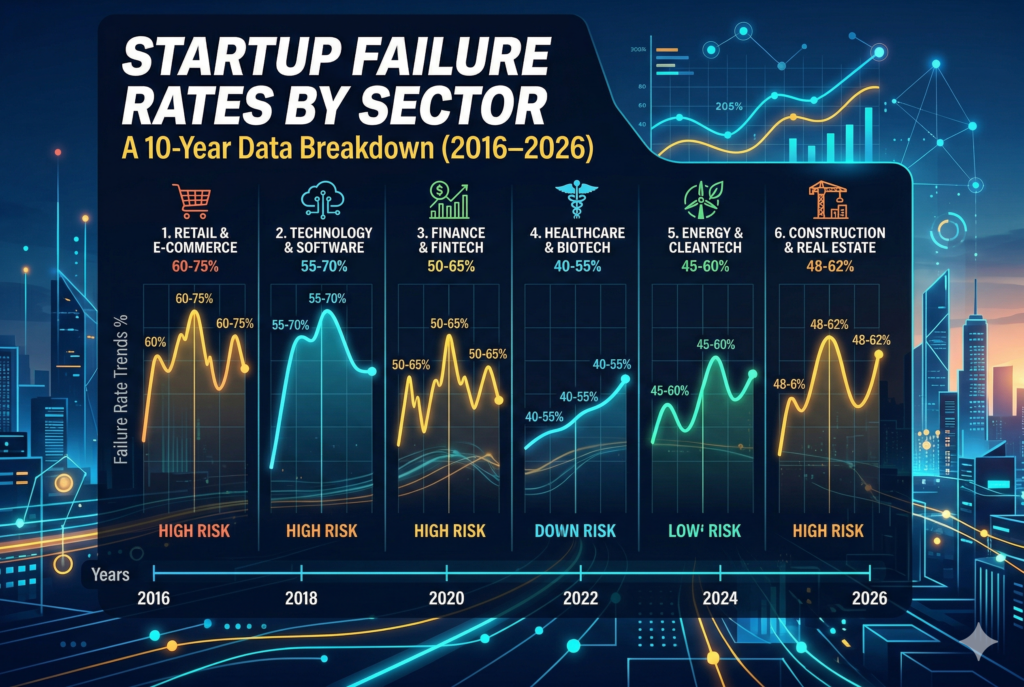
Startup Failure Rates by Sector: A 10-Year Data Breakdown (2016–2026)
by Andy Jamerson — April 2026
Startup mortality data is frequently cited and rarely disaggregated. The headline figure — that approximately 90% of startups fail — has circulated in business media for over a decade without the sectoral nuance necessary to make it analytically useful. A decade of data from 2016 through 2026 reveals failure rates that vary dramatically by sector, funding stage, founding team characteristics, and macroeconomic conditions at time of launch. This analysis breaks those patterns down into actionable findings for investors, founders, and operators.
Key Takeaways
- Across all sectors, approximately 20% of startups fail within their first year and roughly 45% fail by year three
- SaaS startups demonstrate the highest five-year survival rate at approximately 32%, compared to 18% for consumer-facing apps and 14% for hardware startups
- Fintech failure rates accelerated sharply between 2022 and 2024 as rising interest rates eliminated unit economics for payment-forward business models
- Startups that raised Series A funding between 2021 and 2022 at peak valuations showed a 61% higher rate of closure or down-round distress by 2025 versus 2019 vintage cohorts
- Founding team composition is the single strongest predictor of five-year survival in pre-seed and seed-stage companies
- Climate tech startups show the lowest failure rate among 2020 to 2023 vintage cohorts, in part due to federal funding backstops
- Median runway at failure across all sectors was 4.2 months in 2024, down from 7.1 months in 2021
Failure Rate Patterns Across Sectors and Vintage Cohorts
The 2016 to 2026 window is analytically rich because it spans a full venture cycle: from the post-2016 recovery period, through the zero-interest-rate-driven peak of 2020 to 2021, into the 2022 to 2023 correction, and into the stabilization visible in 2025 data. Each phase produced distinct failure rate patterns, and companies launched within the same calendar year but in different sectors faced substantially different odds.
SaaS startups consistently showed the best survival profiles of any sector across the decade. The category benefits from low cost-of-goods-sold structures, recurring revenue that provides planning visibility, and high investor familiarity that translates into relatively efficient capital access. There is also a compounding effect worth noting: SaaS companies that reach $1 million in ARR tend to retain proportionally more of their customer base per dollar of sales and marketing spend than comparable consumer businesses, which makes the survival curve steepen meaningfully once early product-market fit is established. That dynamic does not hold for hardware or consumer categories at the same threshold.
Consumer-facing app startups show the most volatile failure distribution of any segment tracked. Successful outcomes in this category are highly concentrated among a small number of category-defining winners, while the remainder fails at rates approaching 85 to 90% at the five-year mark. The structural reason is distribution dependency: most consumer apps rely on a handful of acquisition channels, and any meaningful shift in platform policy, algorithm behavior, or paid channel cost can eliminate months of growth momentum. Consumer apps launched between 2019 and 2021 faced an additional dynamic when iOS 14.5 privacy changes took effect and reshaped mobile attribution, raising effective CAC for many categories before founders had time to adjust their unit economics assumptions.
Hardware and deep tech startups have the highest absolute failure rates, driven by capital intensity, long development cycles, and manufacturing risk. The median hardware startup requires 2.4 times more capital to reach the same revenue milestone as a comparable SaaS startup. That multiple understates the compounding effect on failure probability: each additional capital raise is a new opportunity for a deal to fall through, for dilution to misalign founding team incentives, or for a market timing miscalculation to become irreversible. Deep tech companies in robotics and advanced manufacturing faced the additional complication that supply chain disruptions from 2021 through 2023 extended development timelines and increased bill-of-materials costs in ways that were difficult to model at fundraising.
Marketplace startups occupy a middle range. Their failure rates at the five-year mark average approximately 72 to 78%, with survival strongly correlated with achieving liquidity — sufficient transaction volume on both sides — within the first 18 months of operation. The distinction between marketplaces that found liquidity early and those that did not tracks closely with geographic constraint discipline: companies that focused intensely on a single city or category before expanding generally outperformed those that attempted simultaneous multi-market launches with diluted supply.
Founding Team Composition and Early Survival
The data on founding team characteristics consistently surfaces as one of the most underweighted variables in startup failure analysis, particularly at the pre-seed and seed stage where there is often insufficient product or revenue data to do much else besides evaluate the team.
Across sectors, startups with at least one founder who had previously built and exited a venture-backed company showed five-year survival rates approximately 1.8 times higher than first-time founding teams. That gap narrowed considerably when first-time founders had domain-specific expertise in the sector they were entering, suggesting that the operational credibility effect partially substitutes for prior startup experience when the market knowledge is deep enough.
Team completeness at founding also mattered. Startups that launched with identifiable product, commercial, and technical coverage among the founding group — without relying entirely on contractors or plans to hire into gaps — showed higher seed-to-Series-A conversion rates and lower early runway burn relative to companies that were lopsided toward either technical or commercial skills. The implication is not that founding teams need to be large, but that specific functional gaps tend to create expensive hiring urgency at the worst possible time.
Diversity in founding team composition showed a correlation with survival in the data, though the mechanism varies by interpretation. Teams with different prior industry backgrounds showed better ability to adapt business models when initial market assumptions proved incorrect, which is a common event in the seed stage. Single-founder companies, while capable of producing significant outcomes, showed meaningfully higher failure rates in the first two years, largely attributed to the operational strain of executing without a counterpart.
Funding Stage, Valuation Vintage, and Failure Correlation
The 2021 vintage of venture-backed startups represents one of the most studied cohorts in recent history, precisely because the macroeconomic whipsaw that followed produced an unusually concentrated period of stress. Companies that raised at 2021 valuations — which averaged 40 to 60% above historical norms on a revenue-multiple basis — faced a structural mismatch when they attempted to raise again in 2022 or 2023.
Surveyed data from VC portfolio companies indicates that 61% of 2021 vintage Series A companies experienced either closure, asset sale at distressed valuations, or significant down-round financing by the end of 2024. The 2019 vintage equivalent rate was 38%.
The disparity reflects more than valuation mechanics. Companies that raised at peak valuations in 2021 also hired aggressively, committing to cost structures that required growth assumptions baked into those valuations. When growth slowed, the burden of those commitments became load-bearing. Reduction-in-force events that would have been manageable at lower headcount became organizationally destabilizing at the scale many 2021 vintage companies reached. Several well-documented cases in fintech and consumer showed that layoffs themselves triggered customer and partner confidence issues that accelerated the underlying business problems.
Pre-seed and seed stage failure rates were less affected by valuation vintage because those companies had not yet committed to high-multiple raises. Earlier-stage companies that survived through 2023 often did so by dramatically extending runway — cutting burn rates aggressively in a way that later-stage companies with larger team structures could not replicate.
Startups that ultimately survived the 2022 to 2023 correction averaged 37% lower monthly burn rates in Q1 2022 compared to their peers who did not survive.
Cost Structure, Runway Dynamics, and Failure Triggers
Median runway at the point of failure declined significantly across the decade’s later years. In 2021, the median failed startup had approximately 7.1 months of runway remaining when founders made the decision to wind down. By 2024, that figure dropped to 4.2 months.
The compression carries a practical implication beyond the headline statistic. Winding down a company with 4 months of runway leaves substantially less time to run a structured process: exploring acqui-hire conversations, negotiating asset sales, managing employee transitions, or preserving relationships with investors for future ventures. The shortening of the window between “we recognize this isn’t working” and “we have to stop” contributed to worse outcomes across all stakeholder groups in the 2023 to 2024 failure cohort relative to earlier periods.
Personnel costs represent the single largest driver of startup burn across all sectors. Payroll and benefits averaged 58 to 67% of total operating expenses in the 12 months prior to failure. The decision to scale hiring ahead of revenue metrics proved particularly damaging when revenue projections failed to materialize. There is a pattern visible in post-mortems that is worth naming specifically: many founding teams treated headcount growth as a proxy for company health during the zero-interest-rate period, and that habit persisted into 2022 even after the fundraising market shifted. The result was burn rates calibrated to a capital environment that no longer existed.
Customer acquisition cost elevation contributed significantly to consumer-facing startup failures in 2022 and 2023. Digital advertising costs rose substantially as major platforms tightened ad signal quality, increasing median CAC in consumer categories by 31 to 44% between 2021 and 2023. Companies that had built financial models using 2020 and early 2021 CAC data found their payback periods extended to the point where the unit economics no longer supported the business at any reasonable scale. The companies that weathered that shift had generally invested in owned channels — content, community, and referral — during the period when paid acquisition was cheap, giving them alternative acquisition paths when costs spiked.
Approximately 42% of startup founders surveyed after closure cited “no market need” or “insufficient product-market fit” as a primary failure cause — making it the most common answer ahead of funding shortfall, competitive pressure, or operational execution failures. That figure has remained stable across the decade and across sectors, which is itself informative: it suggests that even in a funding environment as unusual as 2020 to 2022, capital abundance did not meaningfully solve the underlying problem of companies building things people did not want enough to sustain a business around.
Leading Platforms in This Space
CB Insights provides comprehensive startup tracking, funding data, and failure analysis, serving as a primary data source for investors monitoring sector-level failure and survival trends.
Crunchbase offers global startup and funding database coverage, with research tools that allow investors and analysts to track cohort survival rates and acquisition outcomes by vertical.
PitchBook delivers detailed venture capital and private equity data, including portfolio company performance tracking and sector-specific failure and exit data.
AngelList serves as both a funding platform and a data source for early-stage startup activity, with particular depth in pre-seed and seed-stage company formation.
Carta manages equity and cap table data for a large portion of venture-backed companies, giving it visibility into funding round timing, dilution events, and company dissolution patterns.
Y Combinator functions as both an accelerator and a longitudinal data source, with over 5,000 alumni companies providing sector-level survival and outcome data.
Startupblink tracks global startup ecosystem health, providing geographic and sector-level analysis of startup formation and mortality rates across over 100 countries.
NVCA (National Venture Capital Association) publishes industry-standard data on venture investment volumes, exit rates, and sector-specific trends.
Platform Comparisons and Alternatives
Academic research on startup failure rates and practitioner-sourced analysis differ in meaningful ways. Academic studies tend to use legally-defined business closure as the failure event, which understates failure because many functionally failed companies remain legally active for years.
Sector-specific failure data from industry associations provides more granular context but varies significantly in methodology — making cross-sector comparisons imprecise when definitions are not aligned. The fintech sector in particular suffers from inconsistent classification: depending on the data source, a company offering embedded payments might be counted as fintech, SaaS, or commerce infrastructure, producing failure rate estimates that span a 15 to 20 percentage point range for the same underlying cohort.
Government-sourced data from the Bureau of Labor Statistics and SBA Office of Advocacy covers business survival broadly but lacks the sector and stage granularity needed for venture-relevant analysis. BLS data consistently shows slightly higher five-year survival rates than venture-focused databases because it includes industries with lower capital intensity and lower growth ambitions.
Investors and founders building models from publicly available data should treat sector-level failure rates as directional rather than precise. The more operationally useful question is not the aggregate failure rate for a given category but the failure rate conditional on specific milestones: what does the survival curve look like for SaaS startups that reach $500K ARR within 24 months, versus those that do not? That kind of conditional analysis, while less frequently published, is the frame that actually informs portfolio construction and operational planning.
What the Data Signals for 2027 and Beyond
Sector concentration among survivors will continue. The 2022 to 2026 correction period functionally culled the weakest cohorts. Companies that survived are, on average, better capitalized, more capital-efficient, and operating in categories with more durable demand. The implication for investors evaluating the current landscape is that the companies still standing have cleared a meaningful filter, and the base rate for quality within the survivor pool is higher than it was at peak formation in 2021. That does not eliminate selection risk, but it reframes it.
Fintech startup formation will remain subdued through 2026 as the sector digests the failure rate spike of 2022 to 2024. Regulatory scrutiny has increased, unit economics require higher interest rate floors than many models assumed, and investor appetite for unproven fintech models has narrowed. The formations that are occurring are concentrated in areas where the regulatory environment is more defined — credit infrastructure, compliance tooling, and embedded finance for established verticals — rather than in consumer-facing payment or lending models that drove the prior cycle.
Climate tech will be the most resilient formation sector through 2027. Federal funding backstops, corporate sustainability commitments, and improving unit economics across solar, battery, and efficiency categories are providing demand visibility and non-dilutive capital rare in any other sector. One nuance worth tracking: the distribution of outcomes within climate tech is widening. Hardware-heavy climate companies, particularly those dependent on large-scale manufacturing, are showing failure rates closer to the broader hardware category. Software-enabled efficiency and grid optimization companies are showing survival profiles closer to SaaS. The aggregate climate tech failure rate is favorable, but it papers over a bifurcation that matters for investors allocating within the category.
AI infrastructure startups represent a formation cohort that did not exist at meaningful scale at the start of the decade and will produce the most closely watched vintage data through 2027 and 2028. The 2023 to 2025 formation cohort in AI tooling and infrastructure is large, has raised at historically high multiples relative to revenue, and is competing in a category where incumbents — including the major cloud providers and model companies — have significant distribution advantages. The failure rate pattern for this cohort will likely track the 2021 vintage in some respects: high formation volume, elevated valuations, and concentration of outcomes among a small number of category leaders.
Methodology
This analysis draws on aggregated data from venture capital databases, academic research on business survival rates, SBA Office of Advocacy business lifecycle data, and industry association reports covering specific sectors including fintech, SaaS, and climate technology. Funding vintage analysis is informed by publicly available round data and secondary market research on portfolio company outcomes.
Conclusion
Startup failure rates are not uniform, and treating them as such produces misleading conclusions for founders, investors, and policy-makers alike. The decade from 2016 through 2026 reveals a clear sectoral hierarchy of survival, with SaaS and climate tech at the top and hardware and consumer apps at the bottom — and a funding vintage effect that shaped outcomes across every sector during the 2022 to 2025 correction.
The variables that most consistently differentiate survivors from failures are not mysterious: capital efficiency, product-market fit discipline, sector selection, and founding team composition account for the majority of the explainable variance in five-year survival across the cohorts studied. What the decade also demonstrates is that external conditions — interest rate environments, platform policy changes, supply chain disruptions — impose costs that no amount of operational discipline can fully offset. The strongest companies managed both: they built durable fundamentals and they adapted when the external environment shifted in ways their models did not anticipate.
The useful frame for the next cycle is not “what is the failure rate” but “which companies have built the structural characteristics that allow them to survive the disruptions that are not yet visible.” That question does not have a tidy answer, but the data from 2016 through 2026 at least clarifies what those structural characteristics look like.

We operate independently with no outside influence, ensuring every insight is grounded in objective analysis.
Independent research.
Clear insights.
Smarter decisions.
Contact