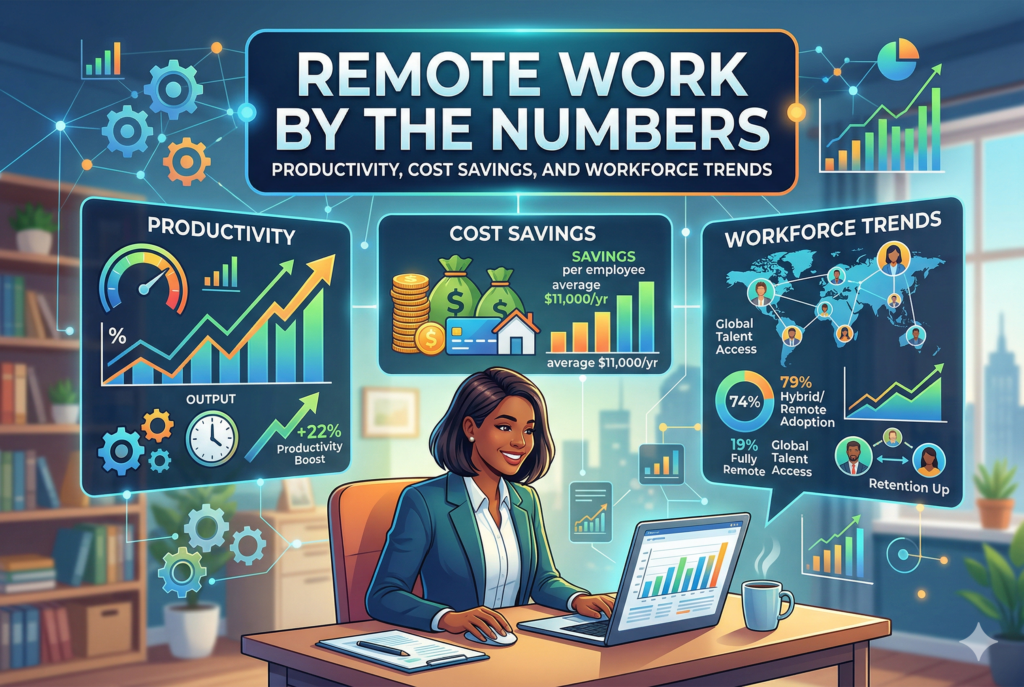
Remote and hybrid work arrangements have stabilized into what appears to be a durable feature of the post-pandemic labor market, though the distribution has settled differently than the 2020 and 2021 optimistic projections suggested. Fully remote work has declined as a share of total employment from its 2020 peak; hybrid arrangements have grown and stabilized; fully in-office mandates have returned at many large organizations. The 2026 data reflects a labor market negotiating a new equilibrium.
Key Takeaways
- 28% of U.S. working days were spent working remotely in Q1 2026, down from 60% at the 2020 peak but significantly above the pre-pandemic 5%
- Hybrid workers report 23% higher job satisfaction than fully in-office workers in consistent cross-sector surveys
- Employer real estate cost savings from reduced office footprint averaged $11,000 per remote employee annually in 2025
- Remote worker productivity is context-dependent: individual focused work shows 13% higher output; collaborative and creative work shows 5 to 10% lower effectiveness in remote settings
- Voluntary attrition rates at companies with RTO mandates ran 14% higher than at comparable companies maintaining flexible policies in 2024
- Companies with structured hybrid policies show lower productivity variance than those with ad-hoc or fully flexible remote arrangements
- Remote work has permanently expanded the geographic talent market, with 34% of knowledge workers now working for employers outside their metropolitan area
Remote Work Distribution and Equilibrium Dynamics
The post-pandemic stabilization of remote work at 28% of U.S. working days represents a level approximately 5 to 6 times higher than the pre-pandemic baseline. Sectoral distribution is highly unequal. Technology, financial services, professional services, and media show remote work shares of 40 to 55% of working days. Manufacturing, healthcare delivery, retail, and hospitality show remote shares below 10%.
Return-to-office mandates at major corporations accelerated in 2024 and 2025. Amazon’s five-day-per-week in-office mandate implemented in early 2025 was the most high-profile. Research tracking mandate effects consistently shows voluntary attrition increases of 12 to 17% in the six months following announced full-time RTO policies — attrition concentrated among higher-tenure, higher-performing employees with the most employment options.
The hybrid model — a set number of required in-office days with flexibility in the remainder — has emerged as the modal arrangement for white-collar employment. The most common hybrid structure globally is two or three in-office days per week. Structured hybrid policies show measurably lower productivity variance than fully flexible arrangements.
Productivity Evidence, Cost Analysis, and Real Estate Dynamics
Individual focused work consistently shows productivity equivalence or modest gains in remote settings, with several controlled studies documenting 10 to 15% productivity improvement. The gains come from reduced commute fatigue, fewer in-office interruptions, and time recaptured from commuting.
Collaborative work, mentoring, creative brainstorming, and client relationship development show consistent effectiveness decline in remote settings. The magnitude varies by study methodology, but the directional finding is consistent across multiple independent research groups.
U.S. commercial office vacancy rates reached record highs between 2023 and 2025, with average vacancy nationally estimated at 18 to 22% by mid-2025. Organizations that right-sized their real estate footprints in 2022 and 2023 are realizing savings averaging $11,000 per remote employee annually.
The average employer technology provision for remote employees averages $4,200 annually per remote worker, up from roughly $1,800 in 2019. The net real estate savings still substantially exceed technology cost increases for most organizations.
Talent Market, Compensation Dynamics, and Geographic Expansion
The 34% of knowledge workers now employed by companies outside their metropolitan area — up from approximately 6% pre-pandemic — represents a structural expansion of employer addressable talent markets and employee addressable employer markets simultaneously.
Survey data shows that 41% of knowledge workers consider remote work availability as a top-three factor in employer selection. Workers accept salary discounts of 2 to 5% on average for fully remote versus required in-office roles at comparable qualification and responsibility levels.
Junior employee development concerns have been cited consistently by talent leaders as the primary risk of sustained hybrid and remote work. Entry-level employees who joined during or after 2020 show slower skill development and career progression in longitudinal studies compared to pre-pandemic cohorts.
Leading Platforms in This Space
Microsoft Teams is the dominant enterprise collaboration platform, integrating chat, video, and file collaboration with the Microsoft 365 productivity suite.
Zoom remains the leading video conferencing platform by usage volume, with expanded capabilities in events, webinars, and AI meeting assistance.
Slack (Salesforce) maintains strong penetration in technology and SaaS companies as a channel-based asynchronous communication platform.
Notion has grown rapidly as a remote team documentation and knowledge management platform.
Asana and Monday.com lead distributed work management, providing project and task visibility across distributed teams.
Loom specializes in asynchronous video messaging, enabling remote workers to communicate complex information through short video recordings.
Miro is the leading virtual whiteboard platform, supporting remote brainstorming, design thinking, and collaborative visual work.
Deel leads global remote payroll and compliance, enabling companies to employ remote workers across international jurisdictions without establishing local legal entities.
Rippling provides integrated remote employee management across HR, IT, payroll, and device management.
Kisi and similar access control platforms serve hybrid workplaces with smart building and desk booking technology.
Platform Comparisons and Alternatives
Synchronous versus asynchronous communication tools reflect a fundamental philosophy about distributed work design. Synchronous tools (Teams, Zoom) replicate the immediacy of in-person communication but require schedule coordination. Asynchronous tools (Loom, Notion, structured Slack) allow time-shifted communication that respects distributed schedules but require greater writing discipline.
All-in-one collaboration suites versus best-of-breed distributed tool stacks differ on integration depth and total cost. Microsoft’s integrated suite offers a single vendor relationship, shared data across applications, and lower per-seat cost at enterprise scale.
Hub-and-spoke hybrid office models versus distributed no-headquarters models represent organizational design alternatives. Fully distributed models (like those pioneered by Gitlab and Basecamp) require more deliberate communication infrastructure investment but show higher geographic talent diversity.
What the Data Signals for 2027 and Beyond
Structured hybrid policies will become the dominant white-collar work arrangement, replacing both full remote and full in-office as the default. The evidence base for hybrid’s advantages in both employee satisfaction and organizational effectiveness is sufficient to inform the majority of policy decisions by 2027.
Remote work technology will increasingly incorporate AI assistance. AI meeting summaries, AI-generated action items, and AI-assisted asynchronous communication will reduce the collaboration tax of distributed work.
Global remote employment infrastructure will mature into a more standardized product category. The proliferation of employer-of-record and global payroll services between 2021 and 2026 has created a functional market for international remote employment; cost and compliance barriers will continue declining through 2027.
Methodology
This analysis draws on Stanford WFH Research tracking data, Bureau of Labor Statistics employment surveys, commercial real estate vacancy data from CBRE and JLL, employer human capital surveys, and academic research on remote work productivity outcomes. Real estate cost savings estimates are derived from commercial real estate market data and organizational cost-per-employee analysis.
Conclusion
Remote and hybrid work in 2026 is neither the revolutionary productivity unlock that 2020 optimism promised nor the organizational disaster that full RTO advocates predicted. The data documents genuine productivity advantages in individual work, real effectiveness costs in collaborative contexts, substantial real estate savings, and significant talent market expansion. Organizations that design work arrangements around evidence rather than ideology will navigate the equilibrium more effectively than those responding to either extreme.

We operate independently with no outside influence, ensuring every insight is grounded in objective analysis.
Independent research.
Clear insights.
Smarter decisions.
Contact