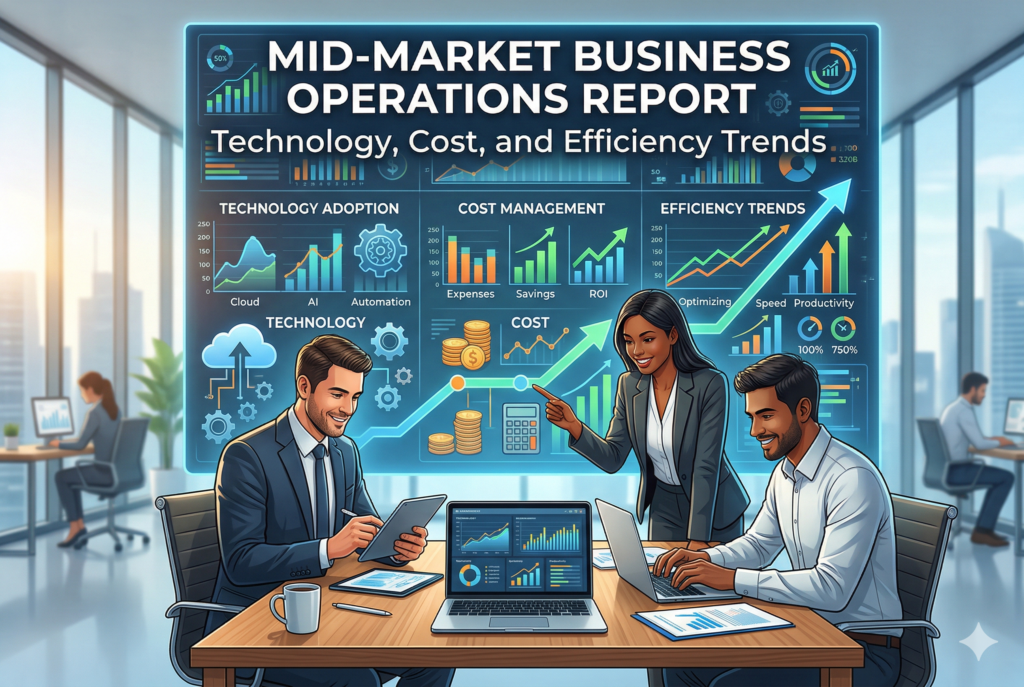
Mid-market business operations — spanning finance, HR, IT, supply chain, and customer operations in companies between $10M and $1B in annual revenue — have undergone significant structural change between 2022 and 2026. Cost pressure from inflation, technology transformation from SaaS adoption, and talent dynamics from post-pandemic labor markets have converged to reshape how this segment operates, spends, and competes.
Key Takeaways
- Mid-market operational technology spending grew 27% between 2022 and 2025, outpacing revenue growth across the segment
- Finance function automation adoption reached 58% of mid-market companies by Q4 2025, with accounts payable showing the highest automation penetration
- Average G&A cost as a percentage of revenue for mid-market companies declined from 14.2% to 12.1% between 2021 and 2025
- HR technology investment per employee grew 31% in the mid-market between 2022 and 2025
- Mid-market supply chain digitization lagged enterprise peers by an estimated 3 to 4 years as of 2025
- Companies with integrated ERP platforms report 22% lower operational overhead as a percentage of revenue compared to peers managing separate point solutions
- Customer operations costs declined 18% on a per-ticket basis among mid-market companies deploying AI-assisted support tools
Technology Adoption Curves and Operational Transformation
Mid-market ERP adoption tells the story clearly. In 2021, approximately 41% of mid-market companies ran a modern cloud ERP system. By 2025, that figure reached 64% — a 23-percentage-point increase in four years. The remaining 36% either rely on legacy on-premise ERP, spreadsheet-based operations management, or disconnected point solutions.
Finance function automation has been the highest-penetration operational technology investment. Accounts payable automation, payroll processing automation, and financial close tooling each show adoption rates above 50% in the mid-market by 2025. The business case for these automations is straightforward and easily quantified: labor cost avoidance per transaction is measurable, error rate reduction is auditable, and cycle time improvements are visible to management.
HR technology investment has grown faster than its operational footprint would suggest. The 31% increase in HR technology spend per employee between 2022 and 2025 reflects the addition of new capability layers (performance management, engagement analytics, learning management) on top of existing HRIS infrastructure.
Supply chain digitization remains the clearest operational technology gap. Fewer than 35% of mid-market companies with physical supply chains have deployed real-time inventory visibility tools. Only 28% have formal demand forecasting systems. Surveyed mid-market companies with undigitized supply chains report 34% higher inventory carrying costs and 19% higher stockout frequencies than peers with modern supply chain tools.
Operational Cost Structure and Budget Allocation
Mid-market G&A costs declined from 14.2% to 12.1% of revenue between 2021 and 2025. Companies that reduced G&A overhead maintained comparable revenue growth rates, suggesting the reduction reflected genuine productivity improvement rather than capacity constraint.
Personnel remains the dominant operational cost component, averaging 68% of total operating expenses across mid-market companies in service-intensive sectors. Technology-driven automation has not significantly reduced headcount — instead, it has enabled equivalent headcount to handle higher volumes.
Real estate and facilities costs declined significantly between 2020 and 2025. The shift to hybrid work models reduced average office square footage per employee by 31%.
IT infrastructure costs show a bifurcated pattern. Companies that completed cloud migrations reduced total IT infrastructure spending by an average of 22% relative to on-premise equivalents. Companies still maintaining on-premise infrastructure saw IT costs increase, driven by hardware refresh cycles and security investment.
Customer operations costs are among the most dramatically affected by AI-driven tool adoption. The 18% decline in per-ticket support cost reflects AI-assisted resolution handling tier-one inquiries without human involvement, agent productivity improvements, and deflection through improved self-service infrastructure.
Efficiency Benchmarks and Performance Gap Analysis
The efficiency gap between the top quartile and median mid-market operator is wider in 2025 than it was in 2021. Technology adoption, specifically the pace and comprehensiveness of it, is the primary driver of that widening.
Top-quartile mid-market companies generate approximately $412,000 in annual revenue per employee, versus a segment median of $247,000. The gap is most pronounced in technology-intensive sectors and narrowest in labor-intensive sectors.
Financial close cycles average 6.4 days among top-quartile mid-market companies versus 12.1 days at the median. Order-to-cash cycles average 19 days at top-quartile companies versus 34 days at the median.
Companies with automated, digitized operations report error rates in invoicing, payroll, and order processing that are 40 to 60% lower than peers relying on manual processes.
Leading Platforms in This Space
NetSuite (Oracle) is the most widely deployed mid-market ERP platform, with particular strength in companies between $5M and $200M in revenue.
Sage Intacct leads cloud financial management for mid-market professional services, financial services, and nonprofit organizations.
Rippling addresses integrated HR, IT, and finance operations for mid-market companies, with growing share among companies seeking to consolidate employee data management.
ADP Workforce Now remains a leading HR and payroll platform in the mid-market, with broad feature coverage across payroll, benefits administration, time management, and compliance.
Zendesk leads customer operations in the mid-market with AI-assisted support tools and ticketing workflows.
Coupa provides spend management and procurement optimization, targeting mid-market finance and operations teams.
Avalara leads tax compliance automation for mid-market companies managing multi-jurisdiction sales tax obligations.
Klaviyo serves mid-market e-commerce and direct-to-consumer companies with marketing automation and customer analytics.
Cin7 provides cloud inventory management for mid-market product companies managing omni-channel inventory and fulfillment.
Ramp leads modern spend management and corporate card platforms in the mid-market, with automated expense categorization and real-time spend visibility.
Platform Comparisons and Alternatives
The choice between integrated mid-market ERP and best-of-breed operational tools is the defining technology decision for this segment. Integrated ERP provides a single data model across finance, inventory, HR, and operations. Best-of-breed allows selecting category leaders at the cost of integration complexity.
Legacy mid-market ERP (on-premise systems from 15 to 20 years ago) versus modern cloud platforms differs most significantly on data accessibility and AI-readiness. Legacy systems hold valuable historical transaction data but in structures that are difficult to expose to modern analytics and AI tools.
What the Data Signals for 2027 and Beyond
Integrated data platforms will become the primary operational differentiator in the mid-market. Companies that can access a unified view of financial, operational, and customer data in near real-time will make better decisions faster than peers managing disconnected systems.
AI-driven operational automation will expand beyond current transactional use cases into operational planning. Demand planning, workforce scheduling, and budget allocation are the next wave of mid-market AI application.
Supply chain digitization will be driven by customer and partner requirements. As enterprise customers implement supply chain visibility requirements, mid-market companies in their supply chains will face external pressure to accelerate digitization timelines.
Methodology
This report draws on aggregated data from mid-market business operations surveys, ERP vendor adoption statistics, third-party research on operational efficiency benchmarks, and publicly available financial data from mid-market company filings. Efficiency benchmarks represent averages from surveyed organizations stratified by operational technology maturity.
Conclusion
Mid-market operational transformation is progressing unevenly but directionally toward greater automation, data integration, and efficiency. The performance gap between technology-mature and technology-lagging companies is widening, which means the cost of delayed adoption is rising annually. Operational technology investment at this point in the market cycle is not discretionary expenditure — it is infrastructure spending that directly determines competitive position.

We operate independently with no outside influence, ensuring every insight is grounded in objective analysis.
Independent research.
Clear insights.
Smarter decisions.
Contact