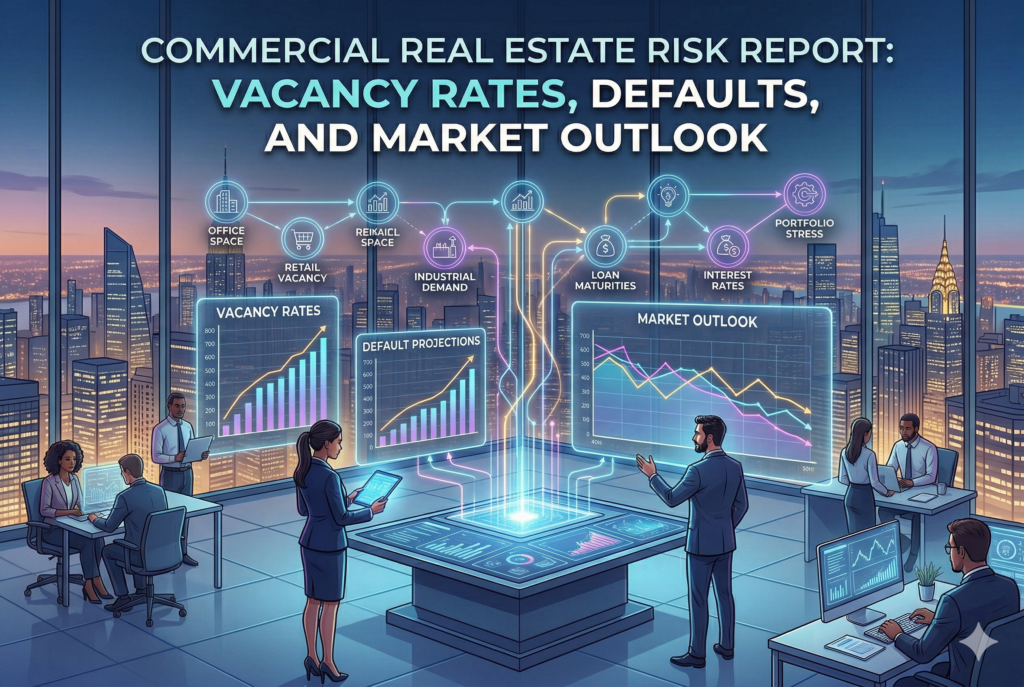
Commercial Real Estate Risk Report: Vacancy Rates, Defaults, and Market Outlook
Commercial real estate entered 2026 in the midst of one of the most significant structural adjustments in the sector’s modern history. Office properties bear the greatest stress, driven by the sustained reduction in office utilization following hybrid work adoption. The stress is not uniform across asset classes — industrial and logistics properties have experienced strong demand, multifamily is navigating oversupply in some markets, and retail has shown surprising resilience in experiential and grocery-anchored categories. What makes this cycle different from prior CRE corrections is the structural nature of the demand shift in the sector’s largest asset class. The 1990s CRE correction was driven by overbuilding. The 2008 to 2010 correction was driven by credit markets. This correction is driven by a permanent change in how and where people work, which means the demand recovery that ended prior cycles cannot be assumed to operate in the same way or on the same timeline. That distinction matters for every participant in the market, from lenders sizing reserves to investors underwriting distressed acquisitions.
Key Takeaways
- U.S. office vacancy reached a record 19.4% in Q4 2025, with effective vacancy (including sublease space) approaching 25%
- Office property values declined an estimated 35 to 55% from 2021 peaks in major U.S. markets
- Commercial real estate loan maturities of approximately $2.4T are scheduled through 2026 and 2027, creating refinancing pressure at current higher rate levels
- Industrial vacancy remained low at 5.8% nationally through 2025 despite significant new supply deliveries
- CRE default rates rose to an estimated 4.2% by mid-2025, concentrated in office and retail categories
- Regional and community banks hold approximately 67% of outstanding CRE loans, creating concentrated credit risk in smaller institutions
- Multifamily rents declined 3.1% nationally in 2025 as supply outpaced demand in Sun Belt markets
Office Sector: Vacancy Dynamics, Value Declines, and Structural Demand Shift
The office sector’s structural challenge is not cyclical. Vacancy at 19.4% nationally reflects both remote and hybrid work reducing average space utilization and companies pursuing lease consolidations as existing leases expire. The near-term trajectory depends on lease expiration schedules — many companies signed long-term leases in 2018 to 2020 that will expire between 2025 and 2028. As those leases roll, the companies that signed them will make binary decisions about their office footprint, and the data from leases already renewed indicates that most are taking less space. Average lease renewal square footage is running 15 to 25% below the expiring lease in most markets, which means that even companies choosing to stay in office space are contributing to rising vacancy. The quality bifurcation within office is stark. Class A office in central business districts shows vacancy of approximately 15 to 18%. Class B and C suburban office shows vacancy exceeding 30% in many markets, with effective vacancy approaching 40%. Capital availability bifurcates similarly — lenders and equity investors are still underwriting class A in primary markets, while class B and C in secondary markets struggle to attract capital at any pricing. The flight to quality is visible in leasing activity data: new leases signed in 2024 and 2025 are disproportionately concentrated in newer, amenity-rich buildings with modern HVAC, flexible floor plates, and proximity to transit. Tenants that are bringing employees back to the office are using the quality of the workspace as a retention tool, which means older commodity office space is losing tenants not just to remote work but to better buildings. Office-to-residential conversion has emerged as a significant policy and investment theme. Technical conversion requirements limit the candidate pool to approximately 25 to 30% of distressed office properties in most markets. The constraints are physical: deep floor plates with interior space far from windows, inflexible structural grids, and mechanical systems that cannot economically be adapted to residential use eliminate the majority of office buildings from conversion candidacy. Buildings constructed before 1980 with narrower floor plates and operable windows are the most viable candidates. Local and federal tax incentive programs are improving marginal project economics, and several cities including New York, Chicago, and Washington D.C. have streamlined zoning approval processes for office-to-residential conversions. Still, the volume of conversions completed or underway represents a small fraction of total distressed office inventory. Gateway city office markets (New York, San Francisco, Chicago, Washington D.C.) and Sun Belt markets (Dallas, Atlanta, Phoenix) are showing materially different dynamics. Gateway city vacancy is elevated due to hybrid work adoption; Sun Belt office vacancy is lower, reflecting ongoing corporate headquarters migration and employment growth. San Francisco stands out as the most distressed major office market, with vacancy above 33% and property values in some sub-markets down more than 60% from 2019 levels. The combination of tech sector remote work adoption, concentrated industry exposure, and population outmigration has produced a correction deeper than any other major U.S. office market.CRE Loan Maturity, Refinancing Stress, and Default Patterns
The $2.4T in commercial real estate loans scheduled for maturity through 2026 and 2027 represents the most acute near-term credit risk in the sector. Loans originated at peak valuations in 2019 to 2022 are maturing into a market where property values have declined 15 to 55% and interest rates remain significantly above origination levels. A loan originated at a 65% loan-to-value ratio on a property that has since lost 40% of its value now exceeds 100% LTV, meaning the borrower owes more than the property is worth. That math applies to a significant portion of the maturing loan book, particularly in office. “Extend and pretend” has been widely employed but is reaching its limits. Regulatory guidance from bank examiners has increased pressure on lenders to recognize losses on clearly impaired assets. The backlog of maturity-extended loans requiring resolution is estimated at $600B to $800B, concentrated in office and retail categories. The extend-and-pretend strategy worked as a temporary measure when there was reasonable expectation that values would recover within the extension period. For many office properties, that expectation is no longer supportable, and examiners are requiring banks to reclassify loans accordingly. The reclassification triggers higher capital reserve requirements, which in turn constrains the bank’s ability to make new loans. Regional and community banks’ 67% concentration of CRE loan exposure creates systemic vulnerability that federal regulators have flagged explicitly. Large banks have been reducing CRE concentration relative to total capital; smaller institutions have not achieved the same diversification. The arithmetic is concerning: a community bank with $2B in assets and 300% CRE-to-capital concentration faces existential risk from a concentrated loss event in its CRE portfolio. Several smaller banks failed or were acquired under distress in 2024 and 2025 with CRE losses cited as the primary cause, and the FDIC’s problem bank list has grown correspondingly. The default rate of 4.2% by mid-2025 remains well below the 8 to 10% levels seen in the 2008 to 2010 cycle. The lower default rate reflects both the extend-and-pretend activity delaying formal defaults and the strength of non-office CRE categories offsetting office distress in aggregate statistics. Office defaults are concentrated in B and C class properties in markets with highest hybrid work adoption. CMBS delinquency rates for office specifically reached 8.1% by late 2025, a figure that more accurately reflects the stress in the asset class than the blended CRE default rate.Industrial, Retail, and Multifamily Sector Dynamics
Industrial real estate has been the strongest-performing CRE category of the past five years, driven by e-commerce fulfillment center expansion, onshoring of manufacturing, and data center development. National industrial vacancy of 5.8% — despite an estimated 850M square feet of new industrial space delivered in 2024 and 2025 — reflects the demand durability of distribution and logistics real estate. Rent growth in industrial has moderated from the 15 to 20% annual increases seen in 2021 and 2022 to 4 to 6% in 2025, but that moderation represents a return to healthy long-term growth rates rather than a sign of weakness. The markets with the tightest industrial vacancy are those with the best combination of port access, highway connectivity, and labor availability: the Inland Empire in Southern California, northern New Jersey, and the Dallas-Fort Worth corridor. Data center demand is growing rapidly enough to constitute its own sub-market. AI infrastructure investment has generated data center demand absorbing power and land at unprecedented rates. Hyperscale data center pre-leasing activity absorbed an estimated 9.2 gigawatts of new capacity announcements in 2024 and 2025. The constraint on data center growth is not capital or demand but power availability. Markets that can deliver large-scale, reliable power are attracting data center development at premium land values. Northern Virginia remains the largest data center market globally, but power grid constraints have pushed new development into markets including central Ohio, Phoenix, and parts of Texas where power availability is less constrained. Retail real estate has shown more resilience than many 2020 projections anticipated. Grocery-anchored neighborhood centers and experiential retail maintain low vacancy rates. The categories of retail that have performed well are those that offer something e-commerce cannot replicate: grocery requires immediate access, restaurants and entertainment require physical presence, and service-oriented retail (medical, fitness, personal care) requires in-person delivery. Approximately 20% of existing enclosed malls are classified as functionally distressed, but the remaining 80% have stabilized or improved performance, particularly those that have repositioned toward experiential tenants and mixed-use configurations. The enclosed mall is not dead as a category; the commodity enclosed mall with undifferentiated department store anchors is. Multifamily faces a supply-driven adjustment. Record apartment deliveries in Sun Belt markets have produced rent declines of 3 to 8% in those markets, while coastal markets with supply constraints maintain rent growth. The Sun Belt overbuilding is most pronounced in Austin, Phoenix, Nashville, and parts of the Atlanta metro, where permitting environments allowed rapid construction response to the demand surge of 2021 and 2022. The supply wave is expected to peak in 2026 before moderating as construction starts, which declined sharply in 2023 and 2024, work through the development pipeline. For investors with a multi-year horizon, the supply-driven rent decline creates acquisition opportunities at below-replacement-cost pricing in markets with strong long-term demand fundamentals.Leading Platforms in This Space
CBRE is the world’s largest commercial real estate services firm, providing brokerage, property management, capital markets advisory, and investment management across all asset classes globally. CBRE’s scale and data advantages make it the default advisory choice for institutional investors and large occupiers. JLL (Jones Lang LaSalle) competes with CBRE across global commercial real estate services with significant presence in corporate occupier services and project management. JLL’s technology investments, including its JLL Technologies venture platform, position it as the most technology-forward of the traditional brokerage firms. Cushman & Wakefield provides full-service commercial real estate advisory with particular strength in tenant representation and corporate services. Blackstone Real Estate is the largest commercial real estate investment manager globally, with significant holdings across logistics, rental housing, and opportunistic credit investments. Blackstone’s ability to deploy capital at scale during distressed periods gives it a structural advantage in cycles like the current one. Brookfield Asset Management manages one of the largest global commercial real estate portfolios, with significant office and retail exposure undergoing repositioning. Brookfield’s willingness to invest new capital into distressed assets within its own portfolio differentiates its approach from managers that prefer to exit troubled positions. Prologis is the dominant industrial REIT, owning and managing logistics properties that serve e-commerce and distribution operations across North America, Europe, and Asia. Prologis controls approximately 1.2 billion square feet of logistics space globally, giving it market power in lease negotiations and development site selection. CoStar Group provides the commercial real estate industry’s primary data, analytics, and marketplace platform. CoStar’s acquisition of LoopNet and Apartments.com has given it a near-monopoly position in CRE listing platforms. Trepp provides CRE loan data and analytics for institutional lenders, investors, and servicers, with particular depth in CMBS loan performance tracking and default prediction. VTS provides commercial real estate leasing and asset management software, offering landlords and brokers deal pipeline management and tenant engagement tools. RealPage leads multifamily property management software, serving apartment operators with revenue management, leasing, and operations optimization tools. RealPage’s algorithmic pricing tools have faced antitrust scrutiny, with lawsuits alleging that coordinated use of its revenue management software by competing landlords constitutes price-fixing.Platform Comparisons and Alternatives
CMBS-financed properties versus bank-financed properties show different distress resolution pathways. CMBS loans, once securitized, are managed by special servicers operating within defined constraints that limit workout flexibility. The special servicer must act in the interest of the bondholders, which often means pursuing foreclosure or forced sale rather than the more patient workout that a bank relationship lender might accept. Bank-held loans offer more flexibility for negotiated extensions and modifications, particularly when the borrower has a broader lending relationship with the institution. The practical implication is that CMBS-financed office properties are more likely to reach the market as distressed sales, creating price discovery that bank lenders would prefer to avoid because it establishes comparable values that force write-downs across similar assets. Office conversion to alternative uses versus repositioning within the office category represents the primary strategic choice for distressed office owners. Full conversion to residential requires capital investment of $200 to $400 per square foot, a timeline of 18 to 36 months, and zoning approvals that can add another 6 to 12 months. Repositioning to class A office requires $50 to $150 per square foot but depends on sufficient tenant demand to justify the investment, which is uncertain in markets where total office demand is declining. A third option gaining traction is partial conversion, where lower floors are converted to retail, food service, or co-working uses while upper floors are converted to residential, creating mixed-use buildings from single-use office stock. Opportunistic CRE investment versus core/core-plus strategies differ in return expectations and risk tolerance. Opportunistic investors targeting distressed office and retail at 30 to 50% discount to peak values accept higher vacancy risk in exchange for potentially outsized returns. Core investors have shifted allocation toward industrial and multifamily, where cash flow stability is higher and structural demand trends are favorable. The capital flow data from 2024 and 2025 shows clear bifurcation: institutional capital is flowing into industrial, data center, and multifamily at near-record volumes while office transaction volume has declined over 60% from 2021 levels.What the Data Signals for 2027 and Beyond
Office distress will continue resolving through a combination of value resets, conversion, demolition, and eventual demand recovery from in-office mandate trends. The resolution will take five to seven years, not two to three. The comparison point is the 1990s resolution cycle in markets like Houston and Denver, where overbuilt office inventory took the better part of a decade to absorb. The current cycle faces a more fundamental demand question than those cycles did, which suggests the timeline could extend further for the most distressed sub-markets. Industrial and data center demand will remain the primary driver of CRE investment activity through 2027. AI infrastructure investment is providing demand for a specialized CRE category that was not a significant factor in prior CRE cycles. The scale of capital committed to AI infrastructure by the major technology companies suggests that data center demand will continue absorbing available supply for the foreseeable future, with power and water availability becoming the binding constraints rather than capital or tenant demand. Regional bank CRE credit quality will be the most closely watched financial stability indicator in 2026 and 2027. The concentration of distressed CRE exposure at smaller institutions that lack the capital buffer to absorb large losses creates regulatory concern that extends beyond the CRE market itself. A wave of community bank failures driven by CRE losses could tighten credit availability in the communities those banks serve, affecting small business lending, residential mortgage origination, and local economic activity in ways that compound beyond the CRE sector.Methodology
This report draws on aggregated CRE market data from CBRE Research, JLL market intelligence, CoStar Group property analytics, Federal Reserve commercial real estate credit surveys, CMBS loan performance data from Trepp, and regional market reports from major commercial real estate brokerage firms.Conclusion
Commercial real estate in 2026 is a market defined by structural change, asset class bifurcation, and refinancing stress concentrated in specific property types and capital structures. The office sector faces a long resolution cycle driven by demographic and work arrangement shifts that are not reversing. Industrial and data center properties are experiencing their strongest demand environment in decades. The credit risk concentrated in regional banks’ CRE portfolios represents the most significant systemic concern requiring continued regulatory and investor attention through the forecast period. The investors and operators who navigate this cycle most effectively will be those who can distinguish between cyclical distress, which creates buying opportunities, and structural obsolescence, which destroys capital permanently.
We operate independently with no outside influence, ensuring every insight is grounded in objective analysis.
Independent research.
Clear insights.
Smarter decisions.
Copyright © 2026 Research 360
Contact