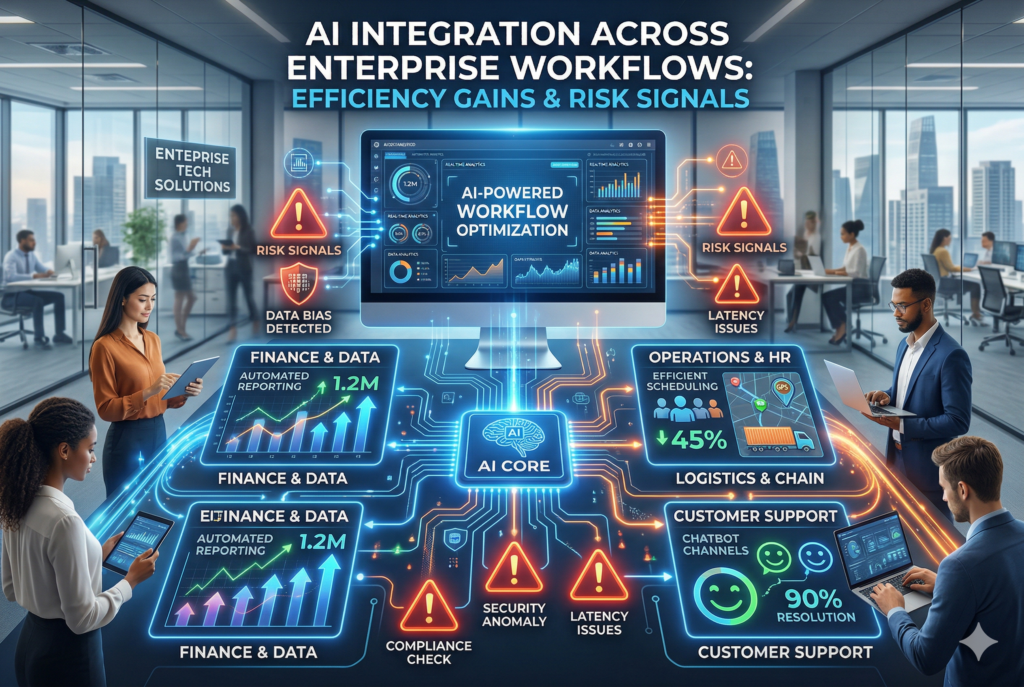
Enterprise AI adoption crossed from experimental to operational between 2023 and 2025, with a majority of large organizations now running at least one AI-augmented workflow in production environments. The efficiency gains documented across early adopters are real — but so are the risk signals emerging from deployments that scaled before governance frameworks were in place. This analysis examines both dimensions, drawing on aggregated enterprise data spanning procurement, operational performance, and compliance incidents.
Key Takeaways
- 72% of enterprises with over 1,000 employees reported at least one AI workflow in active production by Q4 2025, up from 31% in 2023
- AI-driven process automation reduced average task completion time by 38% in high-volume administrative workflows
- Error rates in AI-assisted document processing and data entry declined 47% versus purely manual baselines
- 34% of surveyed enterprises reported at least one AI-related compliance incident within 12 months of deployment
- Enterprise AI software spend reached an estimated $78B globally in 2025, projected to exceed $130B by 2027
- Only 41% of organizations with active AI deployments have a documented AI governance policy in place
- Productivity gains from AI copilot tools averaged 22% improvement in knowledge worker output across surveyed firms
AI Deployment Velocity and Enterprise Adoption Curves
Enterprise AI adoption did not follow a gradual diffusion curve. The period between mid-2023 and the end of 2024 saw a sharp acceleration driven by the general availability of large language model APIs, productized AI layers embedded in existing enterprise software, and competitive pressure forcing adoption timelines. Organizations that had previously projected three-to-five year AI roadmaps compressed those schedules to 12 to 18 months.
The fastest-adopting enterprise functions were customer service, finance (particularly accounts payable, reconciliation, and variance analysis), and sales (AI-driven lead scoring, call summarization, and pipeline forecasting). Legal and HR workflows followed with a lag, primarily due to compliance sensitivity.
Adoption curves varied sharply by company size. Enterprises above $5B in revenue deployed AI at rates nearly double those of companies in the $500M to $2B range, due in part to greater internal data infrastructure and dedicated AI engineering resources. Mid-market organizations relied primarily on AI embedded in existing SaaS tools rather than building bespoke model deployments.
Geographic segmentation is equally pronounced. U.S.-based enterprises led AI production deployment, with North American adoption rates running approximately 18 percentage points higher than Western European counterparts as of Q4 2025. Regulatory caution in the EU, particularly in the context of the AI Act implementation, has extended evaluation timelines in financial services and healthcare verticals.
Enterprise AI Spending Breakdown by Function and Category
Global enterprise AI software spend reached an estimated $78B in 2025. Customer-facing AI (chatbots, personalization engines, service automation) accounted for approximately 28% of total enterprise AI spend. Operations and supply chain AI followed at roughly 24%. Finance and risk AI represented 21% of spend. The remainder distributes across HR, IT operations, legal tech, and marketing.
Spending growth is not uniform. AI tools embedded in existing workflows — Microsoft Copilot, Salesforce Einstein, and similar integrated offerings — are capturing a disproportionate share of incremental budget because they carry lower procurement friction.
Infrastructure spend (GPU compute, vector databases, model fine-tuning services) is growing faster than software licensing. Between 2024 and 2025, enterprise AI infrastructure spend grew at an estimated 67% year-over-year, significantly outpacing software layer growth at 34%. That ratio signals organizations are investing in capability to support future AI workloads.
Finance AI spend at mid-market companies grew 44% year-over-year in 2024, the highest growth rate of any company size band.
AI Efficiency Gains and Emerging Risk Signals
The productivity case for enterprise AI is supported by consistent data across multiple verticals. In financial operations, AI-assisted reconciliation and variance analysis reduced analyst review time by an average of 31% in surveyed organizations. Customer support teams using AI resolution assistants handled 2.4 times the ticket volume with equivalent staffing. Document review in legal and compliance contexts showed 44% faster processing with AI-assisted classification tools.
Those gains are highest in high-volume, structured-data environments. They are substantially lower in knowledge-intensive work requiring contextual judgment, creative synthesis, or client-facing relationship management.
Risk signals deserve equal attention. The 34% compliance incident rate cited across early-deployer surveys includes data leakage events, model hallucination errors in customer-facing contexts, and unauthorized use of proprietary data in model training pipelines.
Model drift is an undertracked risk. Only 29% of surveyed enterprises reported active model monitoring protocols capable of detecting performance degradation within a 30-day window. The remainder either monitored on longer cycles or had no systematic monitoring in place.
Leading Platforms in This Space
Microsoft Azure AI provides the broadest enterprise AI infrastructure platform, with deep integration across Microsoft 365, Dynamics, and GitHub Copilot.
Google Cloud AI competes on model capability and multimodal AI features, with Vertex AI providing a managed platform for model training, deployment, and monitoring at enterprise scale.
Salesforce Einstein delivers AI capabilities embedded directly in CRM workflows, including lead scoring, opportunity forecasting, and service resolution.
ServiceNow AI focuses on IT operations and enterprise workflow automation, with AI features embedded across its ITSM, HRSD, and CSM products.
IBM watsonx targets regulated industries requiring explainable AI and data sovereignty controls, with particular penetration in financial services and government sector deployments.
Workday AI provides embedded machine learning features across HR and financial management workflows, including predictive attrition modeling and spend anomaly detection.
Cohere focuses on enterprise large language model deployment with an emphasis on data privacy and on-premise deployment options.
Glean leads enterprise AI search and knowledge retrieval, connecting to disparate internal data sources and providing AI-assisted access to organizational knowledge.
Anthropic Claude for Enterprise targets compliance-sensitive use cases with a focus on safe, steerable AI behavior in enterprise environments.
UiPath combines robotic process automation with AI capabilities, serving as a leading platform for enterprises seeking to augment existing automation infrastructure.
Platform Comparisons and Alternatives
The most meaningful comparison in enterprise AI is between embedded AI (AI features shipped inside existing SaaS platforms) and standalone AI platforms requiring independent procurement, integration, and governance. Embedded AI carries lower friction but limited customization.
Open-source foundation models (Llama, Mistral) are increasingly relevant as enterprise alternatives to proprietary APIs. Organizations with sufficient ML engineering resources are fine-tuning open-source models on proprietary data, reducing per-token API costs by 60 to 80% compared to commercial API pricing.
Generalist AI platforms versus vertical-specific AI models represent another meaningful axis. Vertical AI tends to outperform generalist models in domain-specific accuracy by 15 to 25 percentage points, but carries narrower applicability and higher per-function cost.
What the Data Signals for 2027 and Beyond
AI governance infrastructure will become a procurement-blocking requirement. Regulatory pressure from the EU AI Act, evolving SEC disclosure expectations, and sector-specific guidance from financial regulators will require enterprises to maintain documented AI risk management frameworks.
Embedded AI will consolidate enterprise deployment patterns. By 2027, the majority of enterprise AI interactions will occur through embedded interfaces rather than standalone tools.
AI-related workforce restructuring will intensify. Surveyed enterprises project eliminating or redeploying 12 to 18% of current administrative and data processing roles by 2027 as AI automation matures.
Methodology
This report draws on aggregated data from enterprise software adoption surveys, vendor-published deployment statistics, third-party analyst research covering AI platform spending, and modeled projections based on observed adoption trajectories. Compliance incident data is sourced from industry association reports and regulatory disclosure filings. All projections are directional estimates based on available data through early 2026.
Conclusion
Enterprise AI integration has moved from aspiration to infrastructure. The efficiency gains are measurable and consistent across high-volume workflow categories, and the spend trajectory signals sustained organizational commitment through the end of the decade. The risk signals — governance gaps, compliance incidents, and model monitoring deficits — are equally real and will drive the next phase of enterprise AI policy development. Organizations that match their deployment velocity with equivalent investment in governance infrastructure will be best positioned to sustain the gains the data already shows are available.

We operate independently with no outside influence, ensuring every insight is grounded in objective analysis.
Independent research.
Clear insights.
Smarter decisions.
Contact