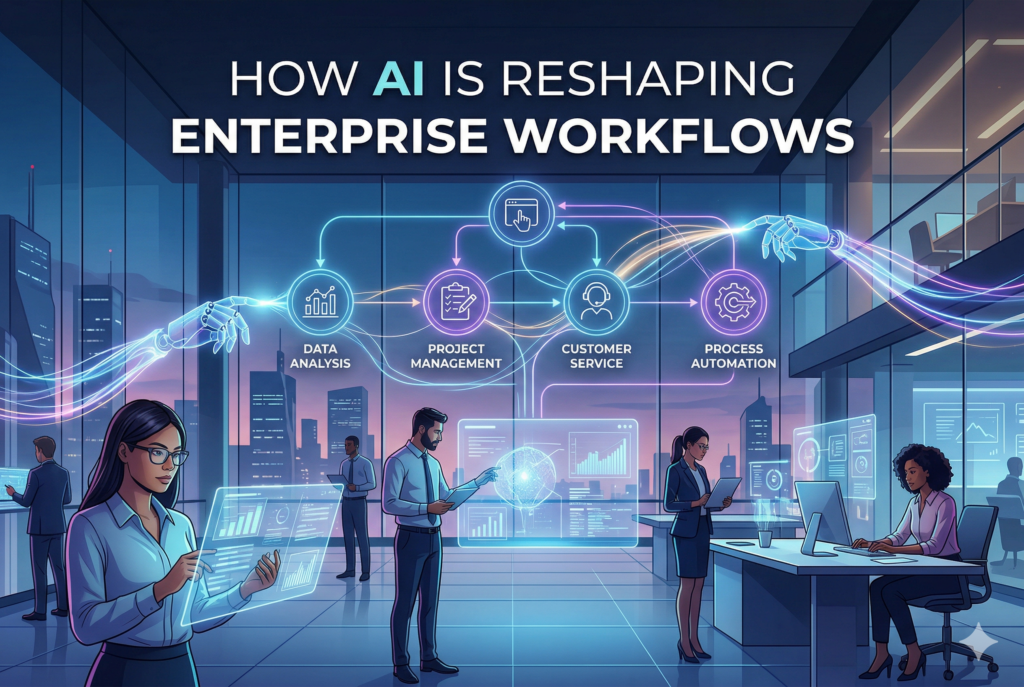
TL;DR: AI has moved from an experimental layer to part of the enterprise infrastructure, reshaping how work gets done across automation, decision support, and cross-department coordination. The efficiency gains are real and increasingly measurable, but so are the risks: data bias, over-reliance on automation, a wider security surface, and workforce adaptation. The best implementations balance efficiency with oversight rather than maximizing automation at all costs.
Artificial intelligence is no longer an experimental layer in enterprise environments. It is actively reshaping how organizations structure workflows, allocate resources, and measure productivity. From back-office automation to executive decision support, AI is being absorbed into operations at a pace that is forcing companies to rethink how work gets done.
As adoption widens, the benefits get clearer, and so do the risks. Understanding both sides is critical for any organization that wants to implement AI in a way that is sustainable, efficient, and secure.
AI Moves Into Core Systems
Enterprise adoption has moved past isolated use cases. What started as limited automation in customer support or data analysis has grown into full integration across multiple business units. Companies are embedding AI into workflow automation, internal communication platforms, analytics and reporting, and customer experience infrastructure.
The push comes from the need to improve efficiency while managing growing complexity. As datasets expand and processes interconnect, AI offers a way to handle scale without adding headcount in proportion. In many cases it is no longer a standalone tool but part of the infrastructure that supports everyday operations.
Efficiency Gains Across Key Areas
The main driver behind adoption is measurable efficiency, and the gains show up in several places.
Process automation now handles routine, repetitive tasks: data entry, scheduling, document processing, and internal reporting. Reducing manual input lowers operational costs, cuts error rates, and frees employees for higher-value work.
Decision support is changing how choices get made. Instead of leaning only on historical reports, businesses can use real-time analysis and predictive modeling to respond faster to market changes, forecast more accurately, and plan with better information. The value is highest where data volume would overwhelm traditional analysis.
Workflow optimization goes beyond individual tasks. By spotting bottlenecks, systems can recommend or automatically make adjustments, reallocating resources by workload, prioritizing tasks dynamically, and streamlining approvals. The result is a more adaptive operation that responds to change without constant manual oversight.
Connecting Siloed Departments
One of the less-discussed benefits is AI’s ability to link previously siloed teams. In many organizations, departments run on separate systems with little visibility into each other. AI can bridge that by consolidating data across platforms, standardizing reporting, and enabling shared insights. The result is a more cohesive operation where decisions reflect a broader view of performance.
Emerging Risks and Challenges
The efficiency gains are clear, but integration brings a new set of risks that need attention up front.
AI systems are only as reliable as their training data. Inaccurate or biased datasets produce flawed outputs, which can reinforce existing biases, generate misleading insights, and erode trust in automated systems. Data sources need vetting, and outputs need regular review.
As AI gets more embedded, there is a real risk of over-reliance. When systems run with little human oversight, errors can spread quickly and at scale. Critical decisions, especially those with financial or operational impact, should still involve human judgment.
Integrating AI also widens the attack surface. Models can be targeted through data manipulation, model exploitation, or unauthorized access to connected systems, so robust security protocols become a core requirement as usage scales.
Workforce adaptation matters too. Employees have to adjust to new tools, workflows, and expectations, and without training and clear communication the transition can cut productivity, breed resistance, and misalign teams and technology. Organizations that invest in training and change management tend to see smoother transitions and better long-term outcomes.
Balancing Efficiency With Control
The most effective implementations do not maximize automation at all costs. They balance efficiency with control. Successful organizations tend to roll AI out incrementally rather than all at once, monitor performance continuously, keep clear oversight mechanisms, and align AI use with broader business goals. That approach reduces risk while still capturing the gains.
What This Means for Strategy
AI is no longer optional for enterprises that want to stay competitive, but how it gets implemented determines whether it becomes an asset or a liability. Companies that approach it strategically, focused on data quality, security, and operational alignment, are better placed to benefit. Those that adopt without a clear framework often hit problems that offset the early gains.
The Bottom Line
AI is reshaping how organizations operate. The efficiency gains are real and increasingly measurable, but they come with complexity that has to be managed. As adoption widens, the question is shifting from whether to implement AI to how to do it well. Organizations that prioritize balance, oversight, and long-term planning will be best equipped to navigate the transition and capture what AI offers.

We operate independently with no outside influence, ensuring every insight is grounded in objective analysis.
Independent research.
Clear insights.
Smarter decisions.
Contact