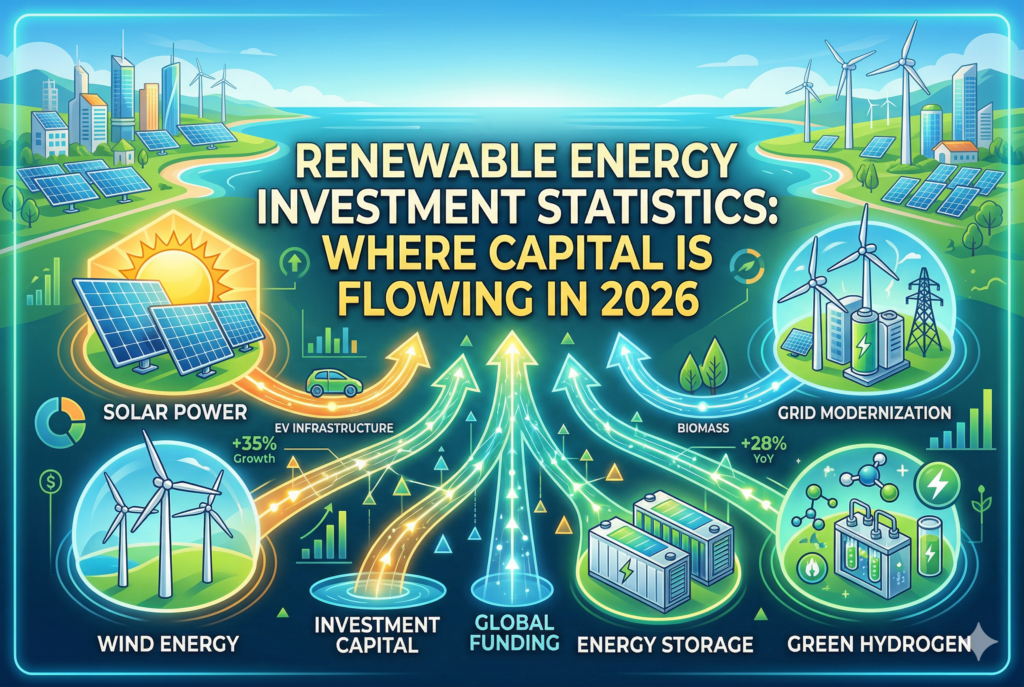
Renewable energy investment reached a new global record in 2025, surpassing $700B in new clean energy capital deployment for the first time and marking the sixth consecutive year of investment growth in the sector. The growth is distributed across solar, wind, energy storage, and grid infrastructure — and is increasingly driven by a combination of energy security concerns, declining technology costs, and policy instruments that have created investment conditions more compelling than at any prior point in the energy transition.
Key Takeaways
- Global clean energy investment reached $715B in 2025, up from $366B in 2020, representing a 14.3% compound annual growth rate
- Solar photovoltaic accounts for the largest single share of renewable investment at approximately 44%, driven by rapidly declining module costs
- Energy storage investment grew 56% year-over-year in 2024, accelerating deployment of battery technology at grid and distributed scales
- U.S. clean energy investment grew 38% in 2024 alone, driven by Inflation Reduction Act tax credit certainty for long-dated projects
- China accounts for an estimated 38% of global clean energy investment, maintaining a consistent leadership position across manufacturing and deployment
- Offshore wind experienced significant project delays and cost escalation in 2022 to 2024, with recovery beginning in late 2025 as contract prices reset
- Clean energy investment now exceeds fossil fuel upstream investment for the fifth consecutive year globally
Investment Volume, Growth Trajectory, and Technology Distribution
The $715B global clean energy investment in 2025 represents a capital mobilization that has systematically altered the energy sector’s investment composition over the past decade. Fossil fuel upstream investment, which attracted approximately $900B annually in 2014, declined to an estimated $580B in 2025, while clean energy investment grew from approximately $250B to exceed it. The crossing of those two trend lines in 2021 was a structural inflection; the gap has since widened.
Solar photovoltaic’s 44% share of renewable investment reflects both its technological maturity and continuing cost decline. Utility-scale solar module costs declined approximately 90% between 2010 and 2024, reaching below $0.16 per watt by mid-2024 — a cost level that makes solar the lowest-cost source of new electricity generation in most markets globally without subsidy.
Onshore wind captured approximately 21% of renewable investment in 2025. Onshore wind is mature and cost-competitive, but faces greater permitting and siting constraints than solar in most markets. Project development timelines for onshore wind average 4 to 7 years from initiation to operation in the United States, constraining deployment velocity relative to solar’s 1 to 3 year timeline.
Offshore wind’s share of renewable investment declined from 14% in 2022 to approximately 9% in 2025 as cost escalation, supply chain constraints, and contract repricing events delayed multiple major projects. New offshore wind contracts awarded in 2025 at higher offtake prices are providing the economics required to restart development pipelines, but the near-term installed capacity outlook has been revised downward.
Energy storage investment growth of 56% year-over-year in 2024 reflects the technology’s increasing necessity as variable renewable penetration requires dispatchable storage to maintain grid reliability. Battery storage costs at the grid scale declined approximately 80% between 2015 and 2024.
Geographic Distribution and Policy-Driven Capital Flows
China’s 38% share of global clean energy investment reflects its dominance across the entire clean energy value chain — from polysilicon production and solar module manufacturing, where Chinese companies account for over 80% of global capacity, to domestic deployment of solar, wind, and storage at scales that dwarf any other single market. China deployed an estimated 230 gigawatts of new solar in 2024 alone, more than the rest of the world combined.
U.S. clean energy investment acceleration is largely attributable to the Inflation Reduction Act (IRA), signed in August 2022. The IRA’s combination of production tax credits, investment tax credits, domestic content bonuses, and transferable credit provisions created investment certainty that has unlocked capital at scales the prior policy environment could not produce. Clean energy manufacturing investment in the U.S. grew from approximately $8B annually before the IRA to over $70B in 2024.
European clean energy investment reached approximately $150B in 2025, sustained by the REPowerEurope agenda that accelerated renewable deployment in response to energy security concerns following the 2022 energy crisis.
India is the fastest-growing clean energy investment market by percentage growth rate, expanding from approximately $12B in 2021 to an estimated $34B in 2025. Solar dominates Indian renewable investment, benefiting from the country’s exceptional solar resource, rapidly growing electricity demand, and government target-setting that creates project development pipelines.
Cost Economics, Returns Analysis, and Capital Efficiency
Levelized cost of energy (LCOE) comparisons between renewable and conventional generation technologies have decisively resolved in favor of renewables in most markets. Utility-scale solar LCOE in the United States ranges from $24 to $42 per megawatt-hour in favorable resource locations, compared to combined cycle gas at $45 to $74 per MWh and new nuclear at $90 to $180 per MWh.
The LCOE comparison is useful but incomplete — it does not capture the system integration costs of variable generation, including the storage, transmission, and grid balancing infrastructure required to make intermittent solar and wind fully substitutable for dispatchable generation. The investment in storage and grid infrastructure represents the next phase of clean energy capital deployment.
Infrastructure fund returns from renewable energy investments have averaged 7 to 12% unleveraged IRR for operating solar and wind assets in developed markets. The asset class has attracted significant capital from pension funds, sovereign wealth funds, and infrastructure managers seeking stable, long-duration, inflation-linked returns.
Green bond issuance reached approximately $580B in 2025, with clean energy projects representing the largest use-of-proceeds category. Corporate power purchase agreements (PPAs) reached 35 gigawatts of new contracted capacity in 2024 globally, with technology companies (Microsoft, Google, Amazon, Meta) accounting for over 40% of corporate PPA volumes.
Leading Platforms in This Space
NextEra Energy is the world’s largest producer of wind and solar energy, with a U.S. utility base that provides stable cash flows supporting one of the largest renewable development pipelines globally.
Orsted leads offshore wind development globally, with projects across the UK, U.S., and Asian markets.
First Solar is the leading U.S.-based solar panel manufacturer, benefiting from IRA domestic content provisions and differentiated thin-film technology.
Brookfield Renewable is one of the largest publicly traded renewable energy investment platforms, operating hydro, wind, solar, and storage assets across North America, Europe, and South America.
BlackRock Global Infrastructure manages a significant clean energy infrastructure investment portfolio, deploying institutional capital across operational renewable assets and development platforms.
Fluence (Siemens/AES) is a leading energy storage technology and services provider, deploying battery storage systems at grid and industrial scale across global markets.
Pattern Energy develops, owns, and operates wind, solar, and transmission infrastructure, with a large development pipeline across North America and Japan.
Invenergy is one of the largest privately held renewable energy developers in North America, with a diversified portfolio spanning wind, solar, storage, and natural gas peaker facilities in transition.
Vestas leads wind turbine manufacturing globally, with significant market share in onshore and offshore wind equipment supply across European and North American markets.
CATL dominates global lithium-ion battery manufacturing for both grid-scale storage and electric vehicles, with a market position that makes it the critical supply chain node for global energy storage deployment.
Platform Comparisons and Alternatives
Utility-scale renewable investment versus distributed generation investment reflects different risk-return profiles. Utility-scale projects (100 MW+) benefit from economies of scale in procurement and construction and established long-term offtake agreements. Distributed generation deploys faster and avoids transmission costs, but involves more complex customer acquisition and contract management.
Merchant renewable exposure versus contracted generation represents a risk architecture choice. Fully contracted assets with investment-grade offtakers carry lower risk and lower return — spreads of 4 to 6% above risk-free rates for long-duration contracted assets. Merchant exposure to spot power prices introduces volatility but provides upside participation in high power price environments.
Green hydrogen investment occupies a separate risk tier from mature renewable technologies. Green hydrogen economics remain uncompetitive with natural gas-derived hydrogen in most markets without subsidy. The technology is advancing — electrolyzer costs are declining rapidly — but commercial scale is 5 to 10 years away for most applications, making it a venture-risk investment rather than infrastructure-risk investment.
Nuclear energy is experiencing a policy and investment revival distinct from the broader renewable trend. Small modular reactor (SMR) technology is attracting venture and government capital as a dispatchable zero-carbon alternative to intermittent renewables. Commercial SMR deployment is not expected before 2030, but investment activity in the category accelerated significantly in 2024 and 2025 as technology companies expressed interest in nuclear offtake agreements for data center power.
What the Data Signals for 2027 and Beyond
Grid infrastructure investment will grow faster than generation investment through 2027. The transmission and distribution upgrades required to connect new renewable generation, enable EV charging at scale, and manage increasing grid complexity represent a capital requirement estimated at $2T globally through 2030.
Energy storage will transition from supplemental to foundational infrastructure. As solar and wind penetration grows past 30 to 40% of generation in leading markets, storage at all timescales becomes structurally necessary rather than economically optional.
IRA policy durability will be the key variable for U.S. clean energy investment through the political cycle. The manufacturing and deployment investment already committed in response to IRA credits is largely proceeding regardless of political changes; incremental new investment decisions are more sensitive to policy certainty.
Emerging market renewable investment will grow as financing mechanisms mature. Blended finance structures combining concessional public capital with private investment are reducing the cost of capital in markets like Southeast Asia, Sub-Saharan Africa, and South Asia — enabling renewable deployment economics that were not achievable when emerging market risk premiums required returns that clean energy projects could not generate.
Methodology
This report draws on International Energy Agency clean energy investment tracking, BloombergNEF new energy finance data, Wood Mackenzie renewable energy market research, U.S. Department of Energy investment tracking, and publicly available financial filings from publicly traded renewable energy companies and infrastructure managers. LCOE figures reflect aggregated estimates from multiple research organizations accounting for regional resource variation. Policy impact analysis draws on Congressional Budget Office IRA analysis and third-party clean energy policy research.
Conclusion
Renewable energy investment in 2026 reflects a capital mobilization that is structurally self-reinforcing: declining costs drive higher deployment, which drives further manufacturing scale, which drives further cost reduction. The $715B in 2025 clean energy investment is not the ceiling — it is a point on a curve that continues upward, driven by energy security imperatives, climate policy, corporate procurement commitments, and the simple economic reality that renewables have become the lowest-cost new generation source in most global markets. The investors, developers, and policymakers that understand the geographic distribution, technology trajectory, and infrastructure requirements of this transition are best positioned to allocate capital to where the growth will be concentrated.

We operate independently with no outside influence, ensuring every insight is grounded in objective analysis.
Independent research.
Clear insights.
Smarter decisions.
Contact