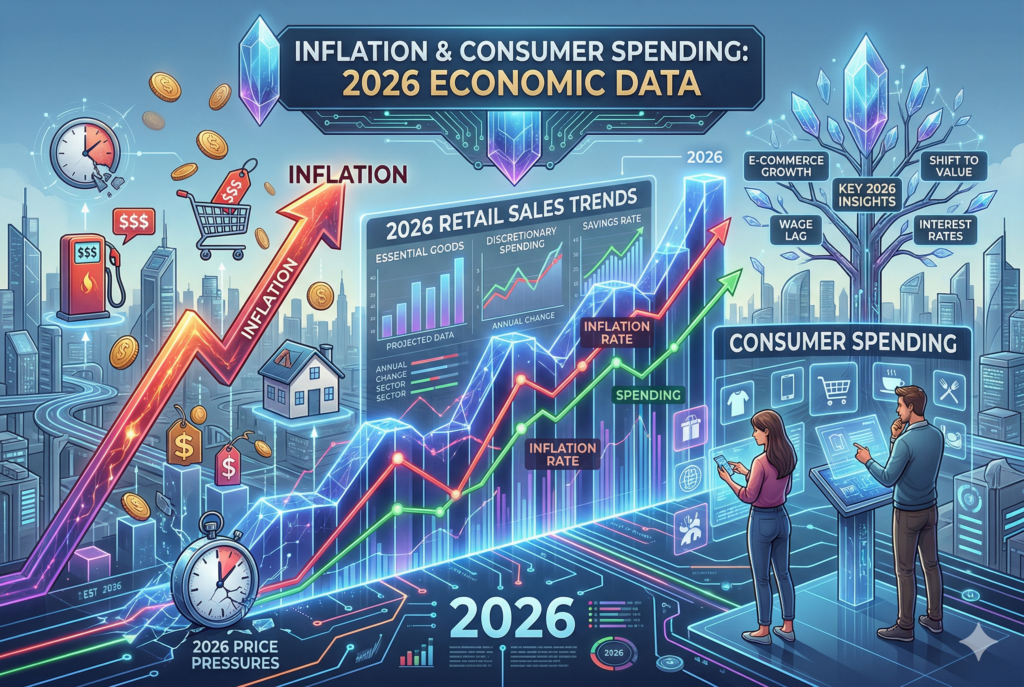
U.S. inflation, measured by the Consumer Price Index, returned to the Federal Reserve’s 2% target range during 2024 — but the return to target masked the cumulative price level increases of the 2021 to 2023 inflationary episode, which left consumer purchasing power permanently adjusted relative to pre-inflation baselines. In 2026, the economic data tells a more nuanced story: headline inflation is controlled, but consumer behavior, credit utilization, and spending patterns continue bearing the imprint of the prior three years’ price shock.
Key Takeaways
- U.S. CPI returned to the 2.1 to 2.4% range through 2025, within the Federal Reserve’s target band
- Cumulative price level increases from 2020 through 2024 totaled approximately 21%, permanently reducing real purchasing power relative to pre-pandemic baselines
- Consumer credit card debt reached $1.21T in 2025, an all-time high, reflecting the use of credit to maintain spending levels despite purchasing power erosion
- Services inflation remained stickier than goods inflation, averaging 3.6% in 2025 versus 0.8% for goods
- Lower-income quintile households spend 14% more of income on necessities (food, energy, housing) in 2025 than in 2019
- Grocery price levels remain 27% above January 2020 levels despite declining food CPI
- Consumer savings rate declined to 3.6% of disposable income in 2025, near historical lows
Inflation Rate Trajectory and Price Level Reality
The distinction between the inflation rate (the pace of price increases) and the price level (the cumulative cost of goods and services) has been the source of the most significant disconnect between official economic statistics and consumer sentiment in the 2023 to 2026 period. When the Federal Reserve and media reported inflation returning to target, they accurately described the deceleration of price increases. What consumers experienced was a price level 21% higher than pre-pandemic, still accruing additional increases at a 2% annual rate.
The Federal Reserve’s rate hike cycle — from near zero in early 2022 to a peak of 5.25 to 5.5% in 2023 — was the primary monetary policy instrument used to decelerate inflation. Its effectiveness in returning CPI to target was achieved at the cost of higher borrowing costs that compressed housing affordability, elevated business borrowing costs, and produced credit tightening that affected small business capital access.
Services inflation proved more persistent than goods inflation throughout the disinflation process. Services price increases of 3.6% in 2025 reflect the labor intensity of service sector production — wages do not reverse once increased, creating a structural floor under service costs that goods inflation does not share. Housing services (rent and owner’s equivalent rent) remained the single largest contributor to above-target inflation even as goods prices normalized.
Grocery prices represent the most politically and behaviorally significant price level effect. The 27% grocery price increase from January 2020 to January 2025 — despite food CPI returning to low single digits annually — represents a compounding of three years of elevated food price increases. Consumer recognition of this price level at every grocery shopping trip was the primary driver of the persistent consumer sentiment pessimism that diverged from strong headline economic metrics through 2023 and 2024.
Consumer Spending Patterns and Credit Dynamics
Consumer spending growth remained positive through 2025, supported by a labor market that maintained low unemployment even as inflation eroded real wage growth. Real personal consumption expenditures grew approximately 2.4% in 2024 and an estimated 2.1% in 2025 — sustained in significant part by declining savings and increasing credit utilization rather than real income expansion.
Credit card debt reaching $1.21T represents both the spending-income gap the inflationary period created and a risk accumulation that will constrain future spending. Average credit card interest rates rose to approximately 22.5% in 2025, the highest on record. Credit card delinquency (90+ days past due) reached 3.5% in 2025, up from 1.8% in 2021, indicating that the debt accumulation is already producing repayment stress at the margin.
Spending category shifts document the consumer response to price level adjustment. Discretionary categories — restaurant spending, travel, entertainment, and apparel — showed real spending growth at higher rates than non-discretionary categories, reflecting a bifurcated consumer environment where higher-income households maintained robust discretionary spending while lower-income households concentrated spending on necessities.
The savings rate decline to 3.6% of disposable income is one of the more structurally significant data points in current consumer economics. Pre-pandemic, the personal saving rate averaged approximately 7 to 8%. The decline suggests consumers are not building financial buffers at rates that would provide resilience to the next shock.
Distributional Impact and Sector-Specific Price Dynamics
The inflationary period’s distributional impact has been disproportionate. Lower-income households, which spend a higher proportion of income on food, energy, and housing — the categories that experienced the most acute price increases — faced real income compression that higher-income households could absorb through substitution.
Lower-income quintile households spending 14% more of income on necessities in 2025 versus 2019 represents a meaningful reduction in economic flexibility affecting spending on healthcare, education, and savings accumulation.
Housing cost burden has increased substantially. The combination of elevated home prices (the median U.S. home price reached $420,000 in 2025, 47% above 2019 levels) and elevated mortgage rates has priced a significant cohort of would-be homebuyers out of ownership. Rental demand remained elevated as a result.
Energy price volatility, while moderated from 2022 peaks, continued affecting household budget variability. Gasoline prices averaging $3.35 per gallon nationally in 2025 remain above 2019 averages in real terms.
Leading Platforms in This Space
Bloomberg Economics provides comprehensive economic forecasting, inflation tracking, and consumer spending analytics used by financial institutions and policy organizations globally.
Morning Consult delivers real-time consumer sentiment and spending data through proprietary survey infrastructure, providing high-frequency readings unavailable from government statistics sources.
NielsenIQ tracks consumer goods purchasing patterns, price sensitivity, and retail category dynamics with granular point-of-sale data across grocery, drug, and mass merchandise channels.
Placer.ai provides foot traffic and consumer mobility analytics for retail and commercial real estate, offering real-time visibility into consumer physical spending behavior.
Moody’s Analytics provides economic modeling, consumer credit analysis, and scenario forecasting used by banks, insurers, and institutional investors managing macroeconomic exposure.
Conference Board publishes the Consumer Confidence Index, a monthly sentiment survey that is among the most closely watched indicators of consumer spending intention.
Federal Reserve Economic Data (FRED) is the authoritative public repository for economic and financial data including CPI components, personal income, savings rate, and consumer credit statistics.
Numerator provides consumer purchase panel data and inflation impact measurement at the household level, offering granularity not available in aggregate price indices.
TransUnion and Equifax provide consumer credit performance data including delinquency rates, utilization, and credit application volumes.
Earnest Analytics delivers transaction-level consumer spending insights from anonymized credit and debit data, providing near-real-time category and retailer spending trend data.
Platform Comparisons and Alternatives
CPI versus PCE (Personal Consumption Expenditures) inflation measurement represents a methodological distinction with policy significance. The Federal Reserve targets PCE rather than CPI, as PCE accounts for consumer substitution behavior when prices rise. PCE typically runs 0.2 to 0.5 percentage points below CPI — meaning the Fed’s 2% target is equivalent to approximately 2.2 to 2.5% CPI.
Survey-based consumer confidence measures versus transaction-based spending data often diverge in directions that require explanation. Consumer confidence surveys frequently reflect backward-looking price level dissatisfaction even when forward spending behavior is resilient — creating the “vibecession” phenomenon observed in 2023 and 2024 where sentiment was negative despite positive spending data.
Real versus nominal spending analysis requires inflation adjustment to reveal true consumption patterns. Nominal retail sales growth of 4 to 5% annually in a 2 to 3% inflation environment represents approximately 1.5 to 3% real spending growth — context frequently omitted from headline retail sales reporting.
What the Data Signals for 2027 and Beyond
Consumer credit stress will be a key economic risk through 2027. The $1.21T in credit card debt at 22.5% average rates represents a structural drag on consumer spending as interest costs consume a growing share of household income. Delinquency rate trends will be the key monitoring metric.
Housing affordability will remain a political and economic priority. The combination of high home prices and mortgage rates above pre-pandemic levels is expected to persist through 2026 and into 2027, maintaining pressure on household formation rates.
Services inflation persistence will keep core inflation above goods inflation for the foreseeable future. Labor market tightness in services sectors — healthcare, hospitality, education — produces wage-cost cycles that moderate slowly, keeping services prices elevated relative to goods prices for multiple years after goods disinflation completes.
Methodology
This analysis draws on Bureau of Labor Statistics CPI and PCE data, Federal Reserve consumer credit and savings rate statistics, household balance sheet data from the Fed’s Financial Accounts of the United States, Consumer Expenditure Survey household budget data, and third-party consumer spending research from market analytics firms. Distributional impact figures reflect Federal Reserve Distributional Financial Accounts and academic research on inflation’s differential effects across income quintiles.
Conclusion
The 2026 consumer economy is navigating the aftermath of the most significant inflationary episode since the 1970s — one that technically resolved to target rates but left a permanently adjusted price level that continues shaping consumer behavior, credit utilization, and spending patterns. The economic data makes clear that the headline inflation rate and the lived consumer experience of economic conditions have remained disconnected through the recovery. Organizations and investors that distinguish between price stability (achieved) and price level normalization (not occurring) will make more accurate assumptions about consumer behavior in the years ahead.

We operate independently with no outside influence, ensuring every insight is grounded in objective analysis.
Independent research.
Clear insights.
Smarter decisions.
Contact