Small business failure statistics are among the most frequently cited and most poorly understood data points in business media. The “90% of businesses fail” formulation still circulates without the methodological nuances or significant variance across industry, geography, and business model that the underlying research documents. This analysis draws on the most rigorous available research to present what the data actually shows — disaggregated by sector, time horizon, and business characteristic.
Key Takeaways
- Approximately 20% of new U.S. small businesses close within their first year; roughly 50% by year five
- Survival rates vary significantly by industry: healthcare and professional services show 5-year survival rates above 55%, while accommodation, food service, and retail cluster below 40%
- Access to capital at formation is the strongest structural predictor of 5-year survival
- Small business closures in 2023 and 2024 elevated slightly above historical baselines as pandemic-era relief programs expired
- Owner-operated businesses (no employees) show higher failure rates but also faster recovery — 38% of failed sole proprietors open a new business within 24 months
- Consumer-facing small businesses show significantly higher failure rates in the 3-to-7-year window than B2B service businesses
- Small businesses in markets with fewer than 50,000 population show 15% lower 5-year survival rates than comparable businesses in metropolitan areas
Survival Rates, Definitional Nuance, and Research Methodology
The variation in reported small business failure rates — estimates ranging from 50% to 90% at the five-year mark — reflects definitional differences more than contradictory empirical findings. Studies using legal business entity dissolution consistently show lower failure rates than those using cessation of business operations.
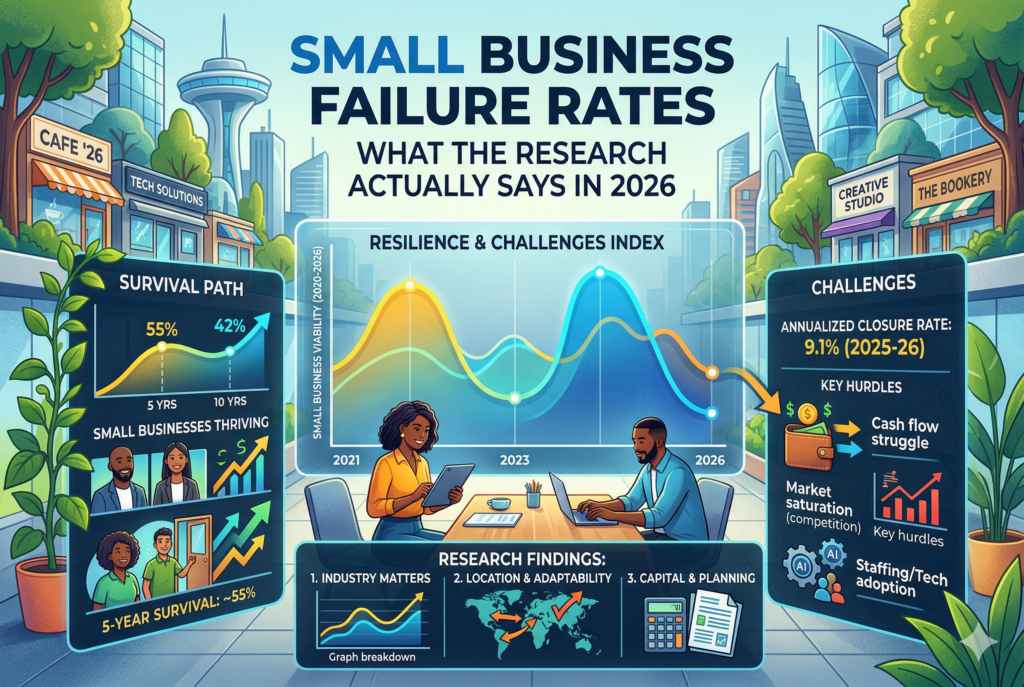
The most methodologically rigorous longitudinal small business data in the United States comes from the Bureau of Labor Statistics Business Employment Dynamics (BED) program. By this measure, approximately 80% of new employer businesses survive their first year, 55% survive five years, and 35% survive ten years.
Non-employer businesses (sole proprietorships with no employees) show lower survival rates. Approximately 60% of non-employer businesses are no longer active by year five, reflecting both lower capitalization and a higher proportion that are side activities rather than primary businesses.
Industry-level survival data shows healthcare, professional services, and financial services consistently demonstrating above-median survival rates. The accommodation and food service industry shows the lowest consistent survival rates, typically 10 to 15 percentage points below the overall average at any given time horizon.
Capital Access, Revenue Model, and Survival Correlation
Capital access at formation is the variable most consistently correlated with small business survival in academic research. Businesses formed with sufficient capital to fund operations for six to twelve months without revenue show survival rates 28 to 35% higher than businesses that begin undercapitalized.
Small businesses with established banking relationships show survival rates approximately 22% higher than those relying exclusively on personal savings. The availability of SBA loan programs has measurable positive effects on survival rates in counties where participating lenders are present.
B2B service businesses with recurring revenue components (retainers, subscription services, ongoing maintenance contracts) show materially higher survival rates than equivalent B2B businesses operating on project-by-project revenue. The predictable cash flow creates planning stability that allows businesses to weather client loss or seasonal variation.
Consumer discretionary businesses face compounded survival risk from highly price-competitive markets, direct e-commerce substitution, and customer concentration risk. The combination produces the industry-level failure rate patterns that persist regardless of macroeconomic conditions.
Cost Structure, Operational Efficiency, and Failure Triggers
Post-mortem surveys of small business owners following closure consistently identify cash flow problems as the most common proximate failure cause, cited by approximately 29% of respondents. Insufficient demand or lack of market need follows at approximately 22%.
Businesses that scale hiring ahead of confirmed revenue — a pattern correlating with optimism bias — show significantly higher failure rates in the 18-to-36-month window than businesses maintaining lean staffing until revenue demonstrates sustainability.
Founder characteristics correlate with survival. Businesses founded by owners with prior entrepreneurial experience show 15 to 20% higher survival rates. Businesses founded by owners with industry-specific experience show 12% higher survival rates.
Inflation impact on small business survival is visible in the 2022 to 2024 data. Small businesses in accommodation, food service, and retail showed elevated closure rates during peak inflation, as cost increases in food, energy, and labor compressed already thin margins before price increases could be fully passed to consumers.
Leading Platforms in This Space
QuickBooks (Intuit) is the dominant small business accounting and financial management platform, with cash flow monitoring, invoicing, and payroll features that support the financial discipline correlated with small business survival.
Square serves small business point-of-sale, payment processing, and financial services including banking and lending.
Gusto leads small business payroll and HR for companies in the 1 to 100 employee range, offering compliance-included payroll processing.
Shopify provides e-commerce infrastructure for small businesses selling online or omni-channel.
HubSpot for Small Business offers CRM and marketing automation tools scaled for small business budgets.
Wave provides free accounting, invoicing, and receipt scanning tools for micro-businesses and sole proprietors.
Lendio operates as a small business lending marketplace, connecting business owners with SBA loans, lines of credit, and alternative financing.
Kabbage (American Express Business Blueprint) provides automated access to small business lines of credit with faster underwriting than traditional bank processes.
SCORE is the SBA-affiliated nonprofit mentoring network providing free business advice with documented positive effects on mentored business survival rates.
Yelp serves consumer-facing small businesses as a review and discovery platform that directly influences customer acquisition.
Platform Comparisons and Alternatives
Self-employment versus employer business represents the fundamental distinction in small business research. Self-employed businesses show higher failure rates, lower revenue ceilings, and greater flexibility in winding down and restarting. Employer businesses show more durable revenue but greater obligation and failure cost when closures occur.
Franchise versus independent small business shows survival rate differences that favor franchises in the first three years, when independent businesses face the steepest operational learning curve. Franchises benefit from established brand recognition and proven operating systems, but face higher capital requirements and ongoing royalty obligations.
Online versus physical location businesses show diverging survival trends. E-commerce-native small businesses face lower fixed cost structures but intense competition and customer acquisition challenges. Physical location businesses face higher fixed costs but benefit from local market presence and in-person customer relationships.
What the Data Signals for 2027 and Beyond
Small business technology adoption will accelerate as AI-augmented tools reduce the operational expertise required to manage financial, marketing, and operational functions. Businesses that historically struggled with financial management or marketing may show improved survival rates as AI tools effectively provide subject matter expertise.
Post-pandemic normalization of survival rates will continue. The pandemic-era distortions — relief-funded survival of businesses that would otherwise have closed, followed by delayed closure as relief programs expired — will largely resolve by 2026.
Climate risk exposure will become a measurable factor in small business survival in geographically exposed markets. Businesses in flood zones, wildfire corridors, and coastal markets face increasing property, insurance, and operational disruption risk.
Methodology
This analysis draws on Bureau of Labor Statistics Business Employment Dynamics data, Census Bureau non-employer statistics, SBA Office of Advocacy survival research, academic research on small business formation and failure drivers, and survey-based research on post-closure owner reporting of failure causes. All figures are directional estimates reflecting the best available aggregate research.
Conclusion
Small business failure rates are real, significant, and highly variable by context. The data does not support either the doom narrative or the uncritical celebration narrative — it shows that the majority of employer businesses survive their first five years, that survival is strongly correlated with capitalization, revenue model stability, and prior experience, and that the businesses most at risk are consumer-facing, undercapitalized, and operating in the most competitive and margin-compressed industry categories.

We operate independently with no outside influence, ensuring every insight is grounded in objective analysis.
Independent research.
Clear insights.
Smarter decisions.
Contact