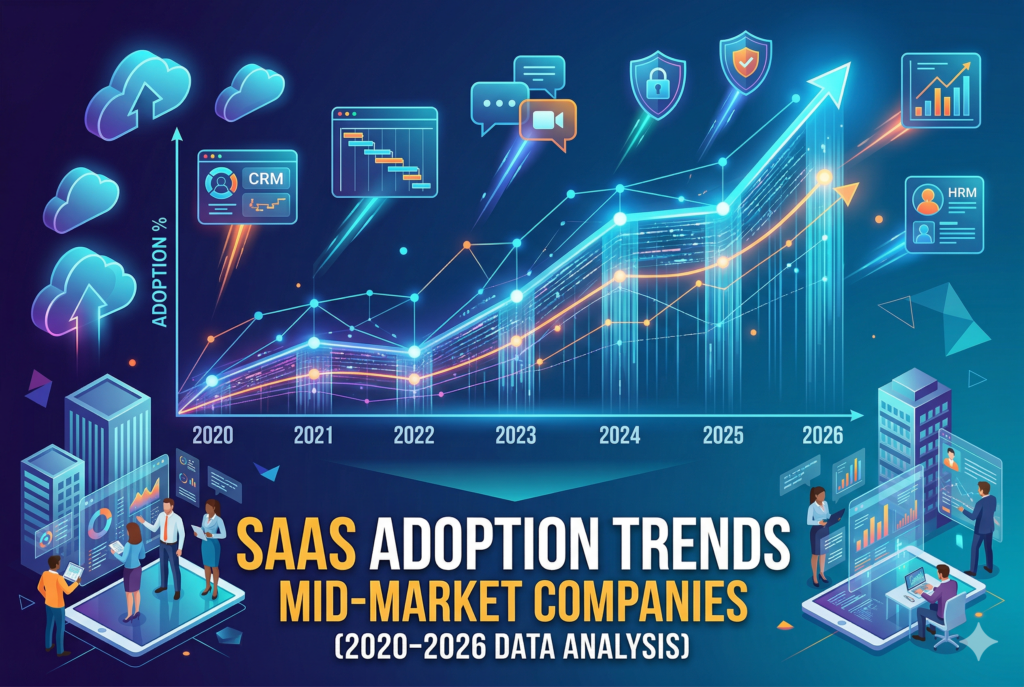
TL;DR: Between 2020 and 2026, the average mid-market company grew its SaaS stack from about 40 applications to more than 130, with annual spend rising from roughly $1.2M to $4.8M. Software went from a procurement convenience to the backbone of operations. Growth has now given way to consolidation, with 68% of CIOs carrying mandates to cut vendor count 20% to 30%, and the defining issues are utilization waste, renewal economics, integration, and governance.
Mid-market companies, generally those generating between $10M and $1B in annual revenue, have driven one of the most consistent software adoption cycles of the past six years. Between 2020 and 2026, the segment grew its average SaaS stack from roughly 40 applications to more than 130, outpacing both SMBs and enterprise accounts in percentage terms. The acceleration reflects remote-work mandates, digital transformation pressure, and more accessible per-seat pricing that lowered the barrier to adoption without lowering long-term cost exposure.
Software is no longer a procurement convenience for these companies. It is the backbone of how they manage growth, coordinate teams, and compete against larger, better-resourced rivals. As the stack matured, the decisions became strategic rather than tactical, and stack consolidation, integration complexity, and budget pressure now define how mid-market leaders think about software.
Key Takeaways
- Mid-market companies now run an average of 130+ SaaS applications, up from about 40 in 2020.
- Annual SaaS spend per company grew from an estimated $1.2M to $4.8M between 2020 and 2026.
- Consolidation accelerated in 2023 and 2024, with 61% of IT leaders reporting active rationalization programs and 68% of CIOs now carrying consolidation mandates.
- Security and compliance SaaS saw the highest growth, about 34% year over year between 2024 and 2026.
- Procurement cycles shortened from an average of 94 days in 2021 to 67 days in 2025.
- Churn for mid-market SaaS customers averages 14% to 18% annually, versus 5% to 8% for enterprise accounts.
- Multi-year contract adoption rose to 44% in 2025, up from 29% in 2022.
Stack Expansion Since 2020
The pandemic forced software adoption in the mid-market. Companies that had run hybrid on-premise and cloud environments shifted to cloud-first infrastructure on compressed timelines, without the luxury of long evaluation cycles. By the end of 2021, aggregated procurement data showed mid-market SaaS spend up 62% over pre-pandemic baselines.
Growth did not slow after that surge. Between 2022 and 2024, adoption ran at an annualized 18% to 22%, against roughly 12% for the broader SaaS market. The gap reflects category-specific demand, since mid-market organizations were late adopters in HR tech, revenue intelligence, and financial operations platforms and are still completing those cycles.
By 2025, the average company ran software across 11 distinct categories, up from 7 in 2020. Category breadth widened even as individual application counts stabilized under consolidation pressure. The net effect is more diverse tooling, higher integration overhead, and growing demand for orchestration platforms that can unify disparate stacks.
Vertical segmentation matters. Mid-market companies in financial services and healthcare adopted compliance-adjacent SaaS at nearly double the rate of manufacturing or retail. Regulatory pressure, not pure operational efficiency, drove much of the adoption curve in those regulated sectors.
Where Adoption Is Concentrated by Function
Penetration is uneven across functions, reflecting where the operational need runs highest.
In sales and customer management, CRM remains one of the most widely adopted categories. Mid-market companies lean on it to manage relationships at scale, track pipeline, and support forecasting, and AI features have widened its utility. In finance and accounting, cloud platforms have replaced desktop-based systems, enabling real-time visibility, faster closes, and better audit readiness. HR software has accelerated as companies scale headcount and face more compliance requirements, with payroll, benefits, performance, and recruiting tools now standard above a certain size. And collaboration and project-management tools surged with remote and hybrid work, supporting asynchronous communication and document management across distributed teams.
Spending Patterns and Budget Concentration
Aggregate mid-market SaaS spend crossed $4.5B by 2025, up from an estimated $1.9B in 2020. Normalized per company, average annual spend now sits between $4.2M and $5.1M depending on vertical and revenue band.
Budget concentration follows a consistent pattern. The top three categories by spend are productivity and collaboration (about 22% of total SaaS budget), CRM and revenue operations (about 19%), and security and identity management (about 16%). The remaining 43% spreads across HR, finance, analytics, legal tech, and industry-specific tools.
Analytics and business intelligence grew most aggressively between 2023 and 2025. Surveyed companies reported a 41% jump in BI-related budgets over that window, with many simultaneously cutting spend on custom-built internal tools.
Vendor concentration is tightening. Four years ago, mid-market companies averaged 34 distinct vendors. The figure is now about 41, but active spend is increasingly concentrated. The top 10 vendors for a given company now account for roughly 74% of total SaaS spend, up from 61% in 2021.
The Consolidation Pressure
A defining trend is the push toward consolidation. Early adoption often left fragmented stacks, with departments picking tools independently of IT or finance. That produced redundant functionality, data silos, unpredictable costs, and more complexity for IT teams managing integrations.
In response, many organizations now run formal stack audits and move toward fewer, more integrated platforms. Vendors offering broad functionality across multiple use cases benefit from the trend, while single-purpose tools face more scrutiny at renewal. Survey data from 2025 shows 68% of mid-market CIOs carry active consolidation mandates targeting a 20% to 30% cut in vendor count over the next two years.
Integration as a Strategic Priority
As stacks consolidate, integration has become a central concern. The value of any one platform increasingly depends on how well it connects to everything else. Mid-market companies are prioritizing native integrations between core platforms, API access for custom connectivity, centralized data environments that pull from multiple systems, and workflow automation that spans tools. Integration failures create friction and erode the efficiency gains SaaS was meant to deliver. Companies that invest in integration architecture early tend to get more long-term value from their software.
Contract Efficiency, Renewals, and Utilization
License utilization remains one of the most underexamined cost vectors. Surveys consistently find that 25% to 35% of purchased seats go unused in a given month. For companies spending $4M or more annually, that is $1M to $1.4M in direct waste.
Renewal economics are improving slowly. The average price increase at renewal dropped from 14.2% in 2022 to 9.8% in 2025, reflecting sharper buyers and more competition in mature categories like CRM, collaboration, and project management. Categories still seeing double-digit renewal inflation include AI-augmented tools and security platforms.
Procurement compression has downstream effects. Companies that shortened cycles to under 60 days reported 22% higher six-month churn than those keeping structured evaluation above 90 days. Speed creates onboarding risk.
Multi-year contracts are gaining traction as a cost-management tool. Vendors offer annualized discounts of 12% to 18% on commitments of two years or longer, enough to convert budget-constrained buyers. The 44% multi-year adoption rate in 2025 marks a clear shift from earlier in the decade.
Risks and Operational Challenges
The benefits are well-documented, but reliance on cloud software brings real challenges. Concentrating operations on a few platforms creates dependency risk, where outages, pricing changes, or strategy shifts hit hard. Storing sensitive data across many SaaS environments adds security and compliance complexity, so vendor standards have to match internal requirements. Buying software is not the same as using it, and companies often see gaps between licensed seats and actual usage without structured onboarding. And integrations accumulated over time can become brittle connections that demand ongoing maintenance and limit flexibility to adopt new tools.
Leading Platforms in This Space
Salesforce anchors mid-market CRM and revenue operations, with strong penetration in companies between $50M and $500M in revenue, though implementation complexity remains a barrier for smaller buyers in that band.
HubSpot has steadily gained share in the $10M to $100M segment, positioned as the operationally lighter option across marketing, sales, and service.
Microsoft 365 remains the dominant productivity platform, present in an estimated 82% of mid-market stacks and serving as foundational infrastructure other tools integrate against.
Workday leads HR and financial management for companies scaling past $200M in revenue, with strong penetration in financial services, healthcare, and professional services.
Okta holds significant share in identity and access management, a core layer for companies running multi-vendor environments.
Zendesk remains a leading support platform, particularly among companies with high-volume support and distributed service teams.
Slack (now under Salesforce) is a primary collaboration tool for technology and services firms, with channel-based workflows embedded in core processes.
Coupa leads spend management and procurement automation for companies consolidating vendor payment and contract workflows.
Rippling has seen rapid adoption for combined HR, IT, and finance management among buyers looking to cut the number of platforms handling employee data.
Gong leads revenue intelligence, with adoption concentrated in mid-market B2B SaaS and technology services.
Platform Comparisons and Alternatives
The most consequential comparison is between all-in-one suites and best-of-breed point solutions. All-in-one platforms offer lower integration overhead and consolidated billing, but often lag specialized tools in category depth. Best-of-breed setups let companies pick category leaders but add integration cost. Companies running 15 or more point solutions report spending 8% to 12% of their total SaaS budget on middleware, API management, or custom integration work, overhead rarely captured in initial vendor comparisons.
AI-native platforms, built with AI workflows as core functionality rather than bolted-on features, are gaining procurement consideration, but adoption stays cautious. Mid-market IT leaders cite data governance as the main barrier, with 58% of surveyed buyers requiring proof of data residency controls before approving a purchase.
What Effective SaaS Strategy Looks Like
The companies that get the most value share a few traits. They approach software decisions with a clear operational framework rather than reacting to sales cycles. They keep visibility into total cost of ownership across the stack. And they treat integration and data strategy as prerequisites, not afterthoughts. The best-positioned organizations have moved from opportunistic tool acquisition to intentional platform governance. They own the stack architecture, not just the individual subscriptions.
The Outlook Into 2027
Rationalization will intensify, with 68% of CIOs targeting a 20% to 30% cut in vendor count over the next two years. AI-augmented functionality will shift from differentiator to baseline requirement, and companies that fail to embed AI-driven automation by 2027 face measurable productivity gaps against competitors. Vertical SaaS is growing faster than horizontal platforms, expanding at an estimated 28% compound annual rate between 2024 and 2026 versus 14% for horizontal categories. And consumption-based pricing keeps displacing seat-based contracts, up from 24% of new contracts in 2022 to 39% in 2025.
Methodology
This analysis draws on aggregated industry analyst reports covering SaaS adoption, spending benchmarks, and contract economics across the mid-market, including vendor procurement surveys, third-party SaaS management platform usage analytics, public financial filings from traded SaaS vendors, and modeled projections derived from observed growth rates. All growth rates and spending estimates are directional approximations based on multiple data points rather than single-source figures.
The Bottom Line
Mid-market SaaS adoption has moved well past the early-growth phase. The segment is now defined by consolidation pressure, procurement sophistication, and growing scrutiny of utilization and renewal economics. The efficiency gains, scalability, and access to enterprise-grade functionality have made cloud software a permanent fixture, but as the stack grows more complex and budgets tighten, the strategic dimension has sharpened. Companies that manage their SaaS portfolios with the rigor they apply to headcount and capital, owning the architecture rather than just the subscriptions, will keep a structural efficiency advantage. The trajectory from 2020 through 2026 makes clear that the mid-market has become one of the most analytically significant segments in the global software market.
Research 360 operates independently, with no outside influence on its analysis.

We operate independently with no outside influence, ensuring every insight is grounded in objective analysis.
Independent research.
Clear insights.
Smarter decisions.
Contact