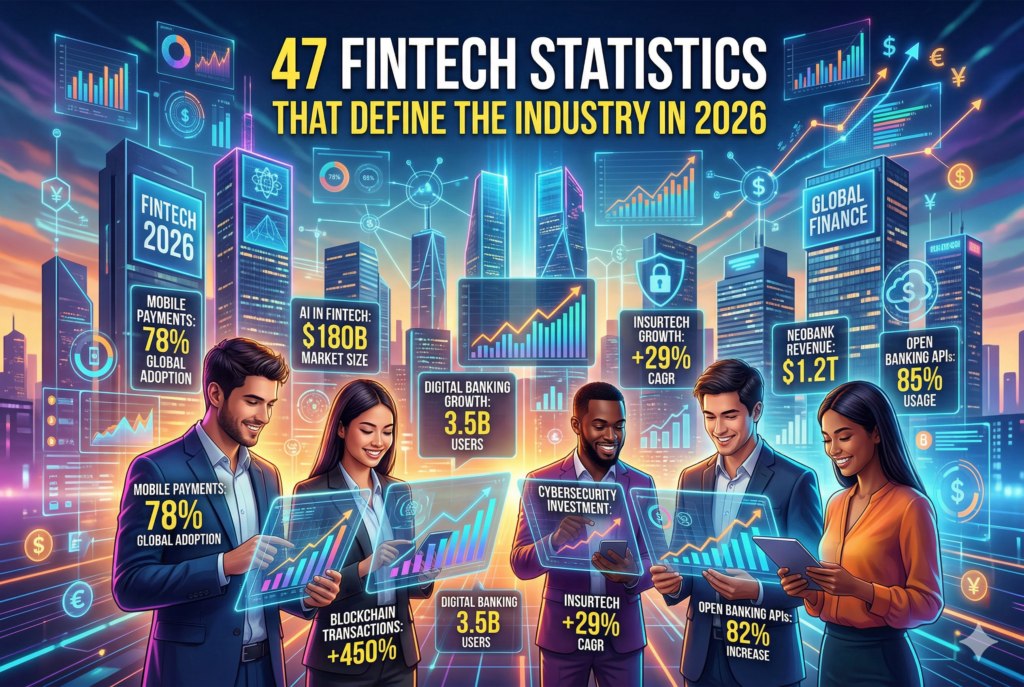
47 Fintech Statistics That Define the Industry in 2026
Fintech has matured from a disruptive fringe category into a core component of global financial infrastructure. Global fintech revenues are projected at $492B in 2026, a figure that reflects both the sector’s scale and its depth of integration into payments, lending, insurance, asset management, and financial infrastructure. The narrative around fintech has shifted accordingly. The 2015 to 2021 story was about disruption: startups attacking incumbent banks with better user experiences and lower cost structures. The 2022 to 2026 story is about integration: fintech companies building the infrastructure layer that both startups and incumbents run on, fintech products embedding into non-financial platforms, and the regulatory apparatus catching up to a sector that outgrew its original classification. The companies that survived the 2022 to 2024 funding correction are, on the whole, structurally stronger than those that thrived in the zero-rate environment. That correction was painful but clarifying.
Key Takeaways
- Global fintech market revenue is projected at $492B in 2026, growing at approximately 15.3% annually
- Digital payment transaction volume reached $11.4 trillion globally in 2025, up from $5.4 trillion in 2020
- Buy now, pay later (BNPL) active users declined 8.3% globally in 2025 after regulatory tightening in the EU and UK
- Neobank account openings surpassed 350 million globally by end of 2025, with Brazil, India, and the UK leading new account growth
- Fintech venture investment fell to $43.2B in 2024 from a peak of $131.5B in 2021, before partially recovering to $56.8B in 2025
- Embedded finance revenue is projected to reach $183B by 2027, representing one of the fastest-growing sub-categories in fintech
- 78% of U.S. adults now use at least one fintech product, up from 58% in 2020
Market Scale, Growth Trajectory, and Category Expansion
The fintech sector’s scale in 2026 reflects over a decade of compound growth. Digital payments represent the largest fintech sub-category by revenue, accounting for approximately 38% of total fintech market revenue in 2025. The dominance of payments is not accidental. Payments sit at the intersection of every other financial product category, which means that companies controlling payment rails have a natural expansion path into lending, banking, insurance, and investment products. Stripe’s evolution from a payment API to a financial infrastructure platform illustrates this dynamic. So does Block’s expansion from point-of-sale hardware into consumer banking through Cash App. India’s UPI processed 117 billion transactions in fiscal year 2025, the highest of any payment network globally. UPI’s scale is significant not just as a national achievement but as a model for real-time payment infrastructure that other countries are studying and in some cases replicating. Brazil’s Pix system processed over 42 billion transactions in 2025, having grown from zero to national-scale adoption in under four years. Both systems demonstrate that government-sponsored real-time payment infrastructure can achieve adoption rates that private payment networks take decades to match. Embedded finance, the delivery of financial products through non-financial platforms, is growing at approximately 26% annually and is expected to be the fastest-growing fintech category through 2028. Embedded lending in e-commerce, embedded insurance in travel booking, and embedded banking in payroll platforms are the most active sub-segments. The embedded finance thesis is straightforward: financial products convert at higher rates when offered at the point of need within an existing workflow than when sold through standalone financial channels. Shopify Capital lending to its merchants, Uber offering driver insurance at the point of ride acceptance, and payroll platforms offering earned wage access are all expressions of this principle. The infrastructure enabling embedded finance, primarily banking-as-a-service (BaaS) platforms and API-first financial product providers, has matured enough that non-financial companies can offer financial products without building the regulated infrastructure themselves. Neobanking has reached sufficient scale to register in national financial statistics. In the United Kingdom, challenger banks now hold an estimated 12% of personal current accounts by volume. Nubank serves over 95 million customers across Brazil, Mexico, and Colombia. The neobank model has proven most successful in markets where incumbent banking infrastructure either underserves large population segments (Brazil, India, much of Southeast Asia) or where incumbent banks charge fees that digital-first competitors can undercut through lower cost structures (UK, parts of Europe). In the U.S., neobank adoption has been substantial in raw account numbers but less disruptive to incumbent deposit share, in part because large U.S. banks have invested heavily in their own digital experiences and in part because U.S. deposit insurance dynamics favor chartered institutions. Insurtech revenue grew 19% annually through 2025, with particular momentum in property and casualty automation, parametric insurance products, and health insurance administration platforms. Parametric insurance, which pays out automatically when a defined trigger event occurs rather than requiring a claims adjustment process, has found strong product-market fit in climate-exposed sectors including agriculture, travel, and commercial property. The parametric model removes the friction and delay of traditional claims processing, which is its primary appeal, but it requires accurate trigger definition and reliable data feeds, which limits its applicability to risk categories where triggering events can be objectively measured.Investment, Valuation, and Capital Flow Dynamics
The fintech venture investment cycle from 2019 through 2025 represents one of the most dramatic boom-and-correction sequences in technology sector history. The $131.5B invested in 2021 reflected both genuine category growth and zero-interest-rate-enabled multiple expansion. The correction to $43.2B in 2024 was correspondingly severe. The 67% decline from peak to trough wiped out paper valuations for hundreds of fintech companies and forced a fundamental reassessment of which business models could generate sustainable unit economics without cheap capital. The partial recovery to $56.8B in 2025 reflects selective re-engagement from institutional investors in sub-categories with proven unit economics: payments infrastructure, B2B fintech, and compliance technology attracted the majority of 2025 investment. Consumer-facing fintech, particularly neobanks and BNPL providers, received a smaller share of 2025 investment relative to their 2021 peak. The investor preference shift toward B2B fintech is rational: B2B fintech companies show lower customer acquisition costs, higher retention rates, and more predictable revenue streams than consumer fintech. Infrastructure and plumbing businesses are less exciting narratively but more defensible economically. The median 2021 fintech IPO traded at 38% below its offer price by end of 2024. That figure includes companies across payments, lending, insurance, and crypto that went public during a window of extreme valuation generosity. The correction was not uniform: companies with strong revenue growth and improving unit economics recovered a portion of their declines, while companies that went public on projected growth that never materialized have seen 60 to 80% permanent value destruction. M&A activity grew significantly in 2024 and 2025 as distressed assets at reset valuations attracted strategic acquirers. Banks, payment networks, and larger fintech platforms used the correction as an acquisition opportunity, buying technology and talent at prices that would have been impossible two years earlier. Secondary market transaction volume for fintech private shares grew 44% in 2024, as early investors and employees sought liquidity in companies that had not progressed to IPO timelines. The secondary market growth reflects a structural problem in late-stage venture: companies that raised at 2021 valuations cannot go public without recognizing a down round, but employees and early-stage investors need liquidity. The secondary market has become a pressure valve for that tension, though transactions typically occur at 30 to 50% discounts to the last primary round valuation.Regulatory, Compliance, and Consumer Protection Dynamics
Fintech regulatory enforcement cases globally totaled an estimated 847 in 2025, a 34% increase from 2023. The increase reflects both expanded regulatory scope and more aggressive enforcement posture. Regulators globally have moved past the initial period of accommodating fintech innovation and are now applying supervisory expectations that approach parity with incumbent financial institutions. The message is clear: if a company offers financial products, it will be regulated as a financial services provider regardless of whether it calls itself a technology company. Open banking API calls in the UK exceeded 11 billion in 2024, a 67% increase year-over-year. The UK remains the most advanced open banking market globally, with a regulatory framework that has been in effect since 2018 and an ecosystem of over 300 regulated third-party providers accessing bank data through standardized APIs. The growth in API call volume indicates that open banking is moving from early-adopter use cases into mainstream financial product delivery, including credit decisioning, account verification, and personal financial management. Digital asset regulation reached a new milestone with MiCA full implementation in the EU. 23% of crypto-adjacent fintech companies have restructured legal entities or jurisdiction of incorporation to align with MiCA requirements. MiCA represents the most comprehensive crypto regulatory framework enacted by any major jurisdiction and is likely to serve as a template for regulatory approaches in other markets. The restructuring activity among crypto fintech companies reflects both compliance necessity and strategic positioning, because MiCA compliance provides a regulatory passport across the entire EU single market. CFPB open banking rules in the U.S. (Section 1033), finalized in late 2024, established data portability rights for U.S. consumers, a development that fintech companies enabling account aggregation had long sought. The rules require large banks to make consumer financial data available through standardized interfaces, which will reduce the reliance on screen-scraping technology that has been the primary data access method for companies like Plaid and Yodlee. The shift from screen-scraping to API-based access improves data reliability, reduces security risk, and creates a more stable foundation for fintech products that depend on bank data connectivity.Spending, Technology Investment, and Infrastructure Modernization
Financial institution technology spending grew to approximately $650B globally in 2025. That figure includes both incumbent bank technology budgets and fintech company technology investment, reflecting the reality that the distinction between “financial institution” and “technology company” has blurred to the point where the categories overlap substantially. Cloud adoption in financial services reached 71% of workloads for leading institutions, up from 42% in 2021. The migration to cloud infrastructure has been a multi-year undertaking for large banks, whose core systems were built on mainframe architectures that predate cloud computing by decades. The remaining 29% of workloads still on-premises are typically the most complex and sensitive, including core banking ledgers and certain regulatory reporting systems that institutions have been reluctant to move. AI investment in financial services surpassed $35B in 2025. The AI spending figure is increasingly difficult to separate from general technology spending because AI capabilities are being embedded into existing products rather than deployed as standalone systems. Fraud detection, credit scoring, customer service, and compliance monitoring all now incorporate machine learning components, which means AI spending is distributed across operational budgets rather than concentrated in a single line item. Cybersecurity investment among fintech companies and financial institutions grew 29% annually between 2023 and 2025. The growth reflects the expanding attack surface that digital financial services create. Every new API endpoint, every new mobile application, and every new data integration represents a potential attack vector. Fintech companies face a particular challenge because their growth depends on connectivity and data sharing, both of which inherently increase security exposure. The regulatory expectation is that security investment scales with digital surface area, and enforcement actions against companies with inadequate security have reinforced that expectation.Leading Platforms in This Space
Stripe is the leading payment infrastructure platform for internet businesses, processing hundreds of billions in annual payment volume. Stripe’s expansion into treasury management, corporate cards, identity verification, and revenue recognition has positioned it as a full financial infrastructure stack rather than a payment processor. PayPal/Venmo maintains the largest consumer payment user base in North America, with over 400 million active accounts. PayPal’s challenge is revenue growth acceleration after several years of decelerating growth, a problem it is addressing through checkout experience improvements and merchant advertising products. Block (formerly Square) serves small business payments, consumer payments through Cash App, and Bitcoin-related financial services. Cash App’s 55 million monthly active users and its expansion into direct deposit, tax filing, and investing have made it a meaningful consumer banking competitor. Plaid provides the leading financial data connectivity infrastructure in North America. Plaid’s network connects to over 12,000 financial institutions and powers data access for thousands of fintech applications, making it a critical infrastructure layer for the broader fintech ecosystem. Adyen is the leading global enterprise payment platform, serving large-scale merchant payment processing. Adyen’s single-platform approach to global payment processing, which avoids the patchwork of regional integrations that competitors require, gives it a structural advantage with multinational merchants. Chime is the largest U.S. neobank by customer accounts, offering fee-free checking and savings products to over 20 million customers. Chime’s revenue model, based primarily on interchange income from debit card transactions, has proven more sustainable than the venture-subsidized fee structures of some competitors. Nubank is the largest digital bank in Latin America, operating across Brazil, Mexico, and Colombia. Nubank’s ability to achieve profitability while serving a predominantly lower-income customer base in emerging markets is one of the strongest proof points for the neobank model globally. Klarna leads European BNPL, with ongoing efforts to transition its revenue model toward a broader financial services platform. Klarna’s strategic challenge is diversifying beyond BNPL before regulatory constraints and competitive pressure compress the margins that funded its growth. Robinhood maintains a significant retail investing platform with expanding cryptocurrency, retirement, and banking product lines. Robinhood’s revenue concentration in payment for order flow has been a persistent concern, and its expansion into retirement accounts and cash management products represents an effort to diversify toward more stable revenue sources. Brex serves venture-backed and growth-stage companies with corporate cards, expense management, and business banking products. Brex’s pivot from serving small businesses to focusing on mid-market and enterprise clients in 2022 was a strategic reorientation that improved unit economics at the cost of total addressable market breadth.Platform Comparisons and Alternatives
Consumer fintech versus B2B fintech presents markedly different risk and return profiles. Consumer fintech carries higher customer acquisition costs, higher churn rates, and greater regulatory exposure. B2B fintech tends to show stickier revenue, higher gross margins, and clearer ROI for enterprise customers, which has driven the investment preference shift visible in 2024 and 2025 venture data. The distinction is not absolute: some of the most valuable fintech companies (Stripe, Adyen, Plaid) serve both consumers and businesses, but their business model economics are anchored in the B2B relationships rather than the consumer endpoints. Embedded finance platforms versus direct fintech customer acquisition represent structurally different distribution strategies. Embedded finance reaches customers at the point of need within existing platform relationships; direct fintech requires building trust and brand recognition from scratch. The embedded model’s advantage is lower customer acquisition cost and higher conversion rates. Its disadvantage is dependency on the platform partner and limited direct customer relationship. Companies like Marqeta, which provides card issuing infrastructure for embedded finance programs, and Unit, which offers banking-as-a-service APIs, are the infrastructure providers enabling this distribution model. Chartered bank versus fintech company operating models differ on regulatory burden, cost of funds, and product breadth. Fintechs that have pursued bank charters (SoFi, Varo) gain deposit-gathering capability and lower cost of funds but accept the full weight of bank regulatory supervision. Fintechs that operate through bank partnerships maintain lighter regulatory obligations but depend on partner bank relationships that can be disrupted by regulatory action against the partner, as several BaaS-related enforcement actions in 2024 demonstrated.What the Data Signals for 2027 and Beyond
AI-native financial products will emerge as a distinct product category between 2026 and 2028. These are not existing financial products with AI features added. They are products that could not exist without AI as a core component: real-time personalized insurance pricing, conversational financial planning, automated tax optimization that adjusts continuously throughout the year, and credit products that update terms dynamically based on real-time financial behavior. The companies building these products are designing around AI capability rather than retrofitting AI into traditional product structures. Fintech and banking convergence will accelerate. The boundary between chartered financial institutions and fintech companies will continue blurring as more fintechs acquire or apply for bank charters and more banks acquire fintech capabilities or build digital-first products. By 2028, the meaningful competitive distinction will not be between banks and fintechs but between institutions with modern technology infrastructure and those without, regardless of their charter status. Real-time payment adoption in the U.S. will accelerate with FedNow service expansion generating new fintech applications in payroll, insurance, and B2B payment categories. FedNow’s availability to all U.S. depository institutions creates infrastructure that fintech companies can build on, similar to how UPI in India and Pix in Brazil created platform effects that enabled rapid fintech innovation. Earned wage access, real-time insurance claim payment, and instant B2B settlement are the most immediate product categories likely to build on FedNow rails.Methodology
Statistics in this report draw on global fintech market research from industry analysts, central bank payment statistics, venture capital investment tracking databases, regulatory enforcement records, and publicly available financial filings from publicly traded fintech companies. All revenue projections are directional estimates based on modeled growth rates from observed market data.Conclusion
Fintech in 2026 is a global, multi-hundred-billion-dollar industry that has moved past its early disruption narrative into a phase of consolidation, regulatory integration, and infrastructure maturation. The investment correction of 2022 to 2024 cleared excess, reset valuations, and redirected capital toward sub-categories with durable economics. What remains is a sector that has permanently altered how payments, lending, and financial data operate, and is now building the next layer of AI-augmented products on that foundation. The $492B revenue figure is large, but the more telling number is the 78% of U.S. adults using at least one fintech product. That adoption rate means fintech is no longer a category that needs to prove consumer demand. The remaining questions are about profitability, regulation, and which business models will compound value over the next decade.
We operate independently with no outside influence, ensuring every insight is grounded in objective analysis.
Independent research.
Clear insights.
Smarter decisions.
Copyright © 2026 Research 360
Contact